

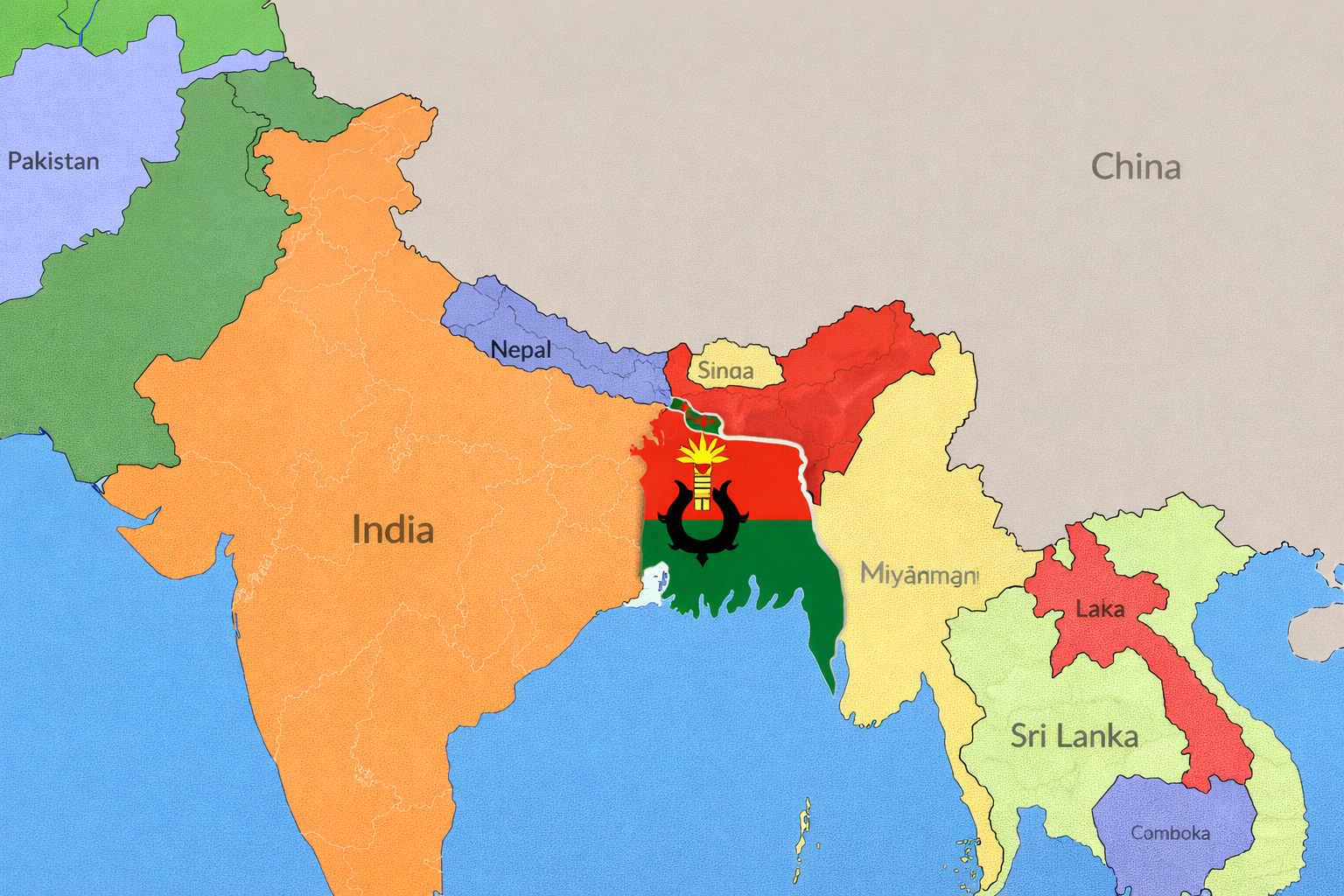
Bangladesh Election 2026 flipped the script overnight. Power shifted. Signals moved fast across borders. While some watched quietly, others acted within hours. A landslide win by BNP led by its leader Tarique Rahman and soon afterwards Narendra Modi’s swift message changed the regional tone instantly. What does this political reset truly mean for South Asia. This article breaks down the stakes, strategy and next moves shaping the moment.
Table of Contents
A Landmark Result on February 12, 2026
Bangladesh Election 2026 concluded with BNP securing a sweeping parliamentary majority, marking the first major national vote since the political upheaval of 2024. International reporting confirmed that BNP and its allies won a dominant share of seats in parliament. (Reuters, Ruma Paul, Krishna N. Das, Tora Agarwala, February 13, 2026, Bangladesh’s BNP wins sweeping election majority, promise of stability) (https://www.reuters.com/world/china/bangladeshs-bnp-wins-two-thirds-majority-landmark-election-2026-02-13/)
a. Why This Win Hits Different
This is not only a party comeback. It is a reset moment for Dhaka’s political order. Reuters framed the vote as a “landmark election,” because the result signals a new phase after months of instability and public anger. (Reuters, Ruma Paul, Krishna N. Das, Tora Agarwala, February 13, 2026, Bangladesh’s BNP wins sweeping election majority, promise of stability) (https://www.reuters.com/world/china/bangladeshs-bnp-wins-two-thirds-majority-landmark-election-2026-02-13/)

b. The Tarique Rahman Factor
AP highlighted how Tarique Rahman returned from London in December 2025 after 17 years away, then stepped into a country still shaped by the 2024 uprising and fresh political trauma. It also noted the pressure ahead, because the road from uprising to election included unrest, minority fears, and rule of law concerns. (Associated Press, Sheikh Saaliq and Julhas Alam, February 12, 2026, Tarique Rahman spent 17 years in exile. He is now poised to lead Bangladesh) (https://apnews.com/article/tarique-rahman-bnp-bangladesh-election-7cf43a8012d036040bb99c2e4be899ca)
Tarique Rahman at the Center of the Transition
Tarique Rahman now stands as the defining political figure of Bangladesh Election 2026. His leadership of BNP places him at the helm of a government expected to navigate both domestic reform and regional diplomacy.
Coverage from Dhaka framed the election as the first historic vote since the ousting of Sheikh Hasina’s administration. The Guardian reported that BNP claimed victory in the “historic first election since overthrow of Hasina.” (The Guardian, Hannah Ellis Petersen, February 13, 2026, Bangladesh election: BNP claims win in historic first election since overthrow of Hasina) (https://www.theguardian.com/world/2026/feb/13/bangladesh-election-bnp-wins)
That context is critical. Bangladesh Election 2026 was not routine. It followed a period of political turbulence. Voters were not simply choosing merely a party. They were choosing direction.
Narendra Modi’s Immediate Response
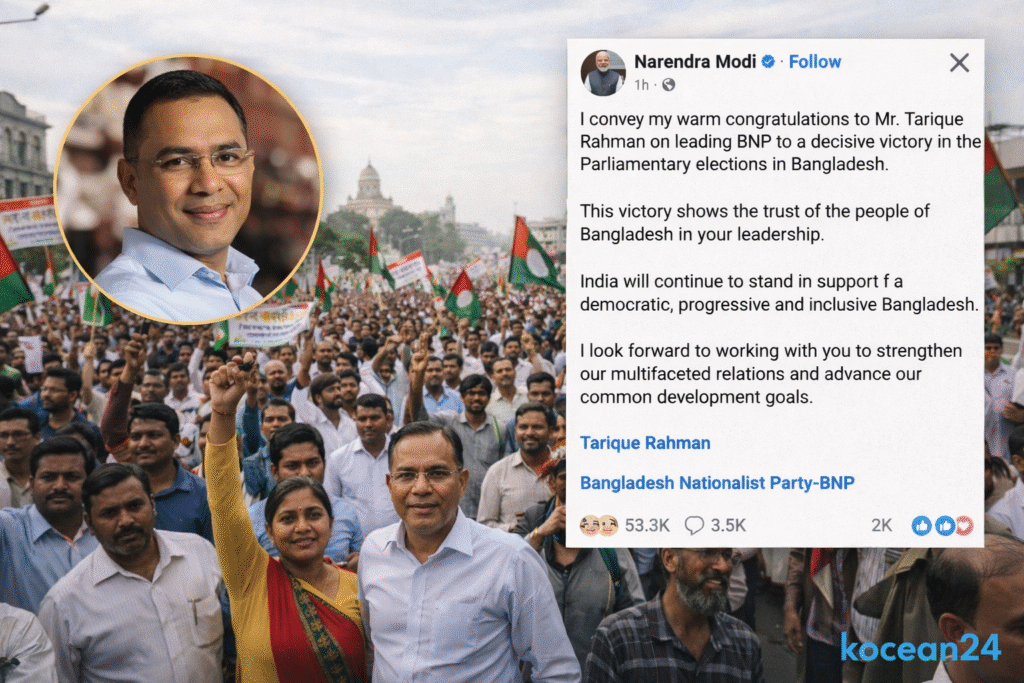
Immediately after the result, Indian Prime Minister Narendra Modi publicly congratulated Tarique Rahman on the electoral outcome. The statement was issued through official channels and emphasized bilateral cooperation.
The Press Information Bureau of India confirmed that the Prime Minister congratulated Rahman and expressed commitment to working with the new leadership. (Press Information Bureau, PIB Delhi, February 13, 2026, Prime Minister congratulates Mr. Tarique Rahman on BNP’s victory in the Parliamentary elections in Bangladesh) (https://www.pib.gov.in/PressReleasePage.aspx?PRID=2227381®=3&lang=2)
The statement also underscored India’s support for “a democratic, progressive and inclusive Bangladesh.” That phrasing is deliberate. “Democratic” signals recognition of the electoral mandate and the importance of institutional stability. “Progressive” reflects expectations of economic continuity, connectivity projects and development cooperation. “Inclusive” points toward social harmony and minority protection, areas closely watched by regional partners and global observers. In diplomatic language, such wording reassures markets, aligns strategic interests and reduces uncertainty at a sensitive political moment.
Timing matters in diplomacy. The speed of India’s acknowledgment signals a desire for continuity and stability in cross border relations.
Why Bangladesh Election 2026 Matters Regionally
Bangladesh Election 2026 matters far beyond Dhaka’s parliament chamber. The country anchors the Bay of Bengal corridor and connects South Asia with Southeast Asia through ports, roads and energy links. It influences river sharing frameworks, cross border supply chains and regional security coordination. A shift in leadership changes tone, tempo and trust across capitals. Markets watch policy signals. Neighbors read diplomatic cues. Stability in Bangladesh strengthens regional predictability. Instability ripples outward fast.
Here is where the regional stakes become sharper:
a. Trade and Transit Corridors
Bangladesh is central to subregional connectivity linking India’s northeast to the sea and to broader Indo Pacific routes. Any policy recalibration affects transit access, customs facilitation and logistics confidence. Continuity keeps corridors fluid. Sudden shifts can slow momentum.
b. Rivers and Resource Diplomacy
Shared rivers shape food security and political trust. Water management requires coordination and calm negotiation. Leadership style influences how disputes are handled and how agreements advance.
c. Security and Border Stability
Border management, counterterror coordination and migration oversight depend on working channels between agencies. Constructive engagement reduces friction. Hard posturing increases risk perception.
d. Strategic Balancing in South Asia
A BNP led administration must project domestic legitimacy while sustaining cooperative ties with major neighbors. Independent positioning earns respect at home. Pragmatic diplomacy preserves leverage abroad.
Governance Challenges Ahead
Winning power is only the first stage. Governing after Bangladesh Election 2026 brings pressure from every direction. Economic momentum must be protected while political expectations rise. Investors track stability. Citizens demand visible reform. Delay weakens confidence.
Institutional credibility now carries heavy weight. A decisive mandate raises standards, not excuses. Transparent administration, accountable leadership and fair oversight become immediate benchmarks. Social trust will not reset automatically. It must be earned through steady action and measurable progress.
The core tests are clear:
• Protect export driven growth and safeguard garment sector confidence
• Strengthen regulatory transparency and electoral integrity
• Maintain border stability and internal security coordination
• Promote inclusive governance to reduce polarization
• Deliver visible reform within the first policy cycle
The coming months will define whether Bangladesh Election 2026 becomes a story of stability or missed opportunity. Mandates open doors. Performance decides legacy.
India Pakistan Rivalry and Future Relations with Bangladesh
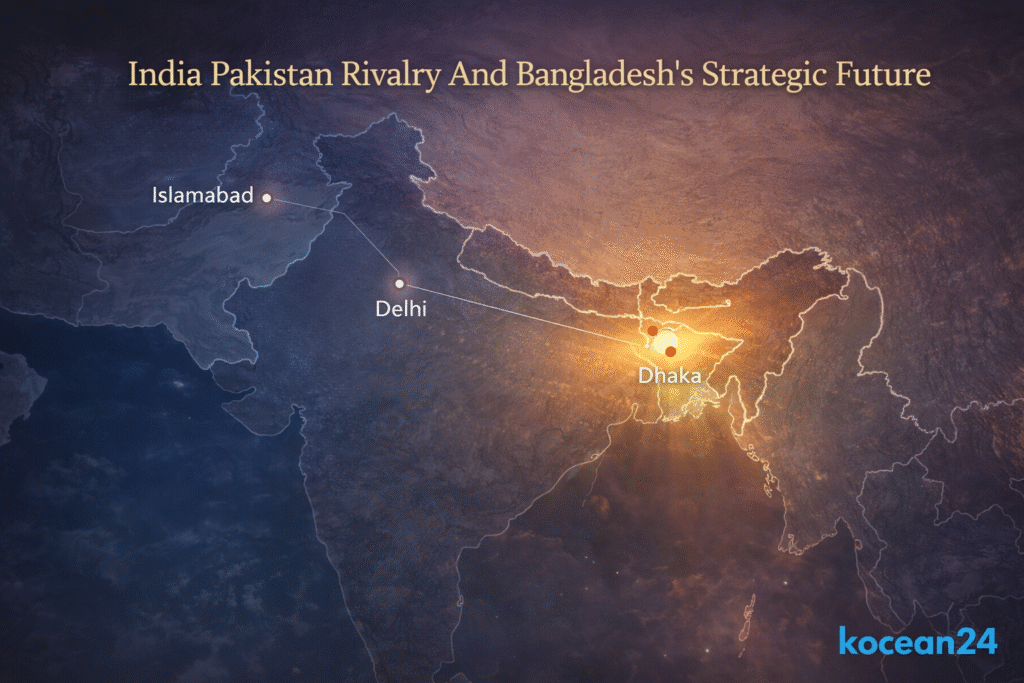
Bangladesh Election 2026 drops Dhaka into a regional triangle where India Pakistan competition never fully disappears. The rivalry shapes security thinking, media narratives and alliance anxiety across South Asia. It also shapes how Bangladeshi parties talk about sovereignty and national interest. The International Crisis Group notes that political actors in Bangladesh have often used anti India sentiment as a strategy, while India’s domestic politics can also complicate ties. (International Crisis Group, no writer listed, December 23, 2025, After the “Golden Era”: Getting Bangladesh India Ties Back on Track) (https://www.crisisgroup.org/rpt/asia-pacific/bangladesh-india/353-after-golden-era-getting-bangladesh-india-ties-back-track)
Bangladesh’s smartest play is usually pragmatic balance, not emotional alignment. A regional analysis from ISAS at the National University of Singapore argues that India Pakistan and Bangladesh share overlapping interests and that stable engagement can reduce friction if handled with realism. (Institute of South Asian Studies, Iftekhar Ahmed Chowdhury, September 16, 2009, India, Pakistan and Bangladesh: ‘Trilateralism’ in South Asia?) (https://www.files.ethz.ch/isn/106132/130.pdf)
Under a BNP led government, Dhaka will face two pressures at once. It must keep cooperation with India working on trade, transit and border management. It must also manage any opening to Pakistan in a way that does not trigger distrust at home or alarm in New Delhi. The real signal will come from policy choices, not speeches. Dhaka can choose cautious equilibrium. It can also choose sharper positioning. Either way, the region will read every move as strategy.
A Strategic Inflection Point
Bangladesh Election 2026 marks a strategic inflection point for South Asian politics. The scale of the BNP mandate resets internal power equations and reshapes the tone of governance. Bangladesh Election 2026 also triggered immediate diplomatic signaling from New Delhi, showing how closely regional capitals track political transitions in Dhaka. This is not routine change. It is a recalibration moment.
The coming months will test whether this transition deepens stability or invites tension. Economic management, institutional reform and foreign policy discipline must move in sync. Regional actors will assess not only statements but policy execution. Power can shift overnight. Enduring stability requires deliberate choices and sustained diplomatic balance. South Asia is watching for signals of maturity, restraint and strategic clarity.
Final Words…
Bangladesh Election 2026 marks a decisive regional shift. Power changed hands and diplomacy responded within hours. The vote reshapes strategy across South Asia and tests leadership under pressure. Stability now depends on balanced choices and disciplined governance. The next chapter will define influence, trust and direction. Stay engaged as this evolving story continues to unfold.




An insightful and well-structured analysis. It is a commendable initiative to interpret the evolving political landscape with clarity and coherence.
Thank you Mr. Biswas. I am delighted that our article succeeded to provide value to you. I highly appreciate your support.
[…] and strategic messaging. (Kocean24, Bangladesh Election 2026: 5 Powerful Signals for South Asia) (https://kocean24.com/bangladesh-election-2026/)) This reflects a broader structural reality in which election dynamics extend beyond borders and […]