

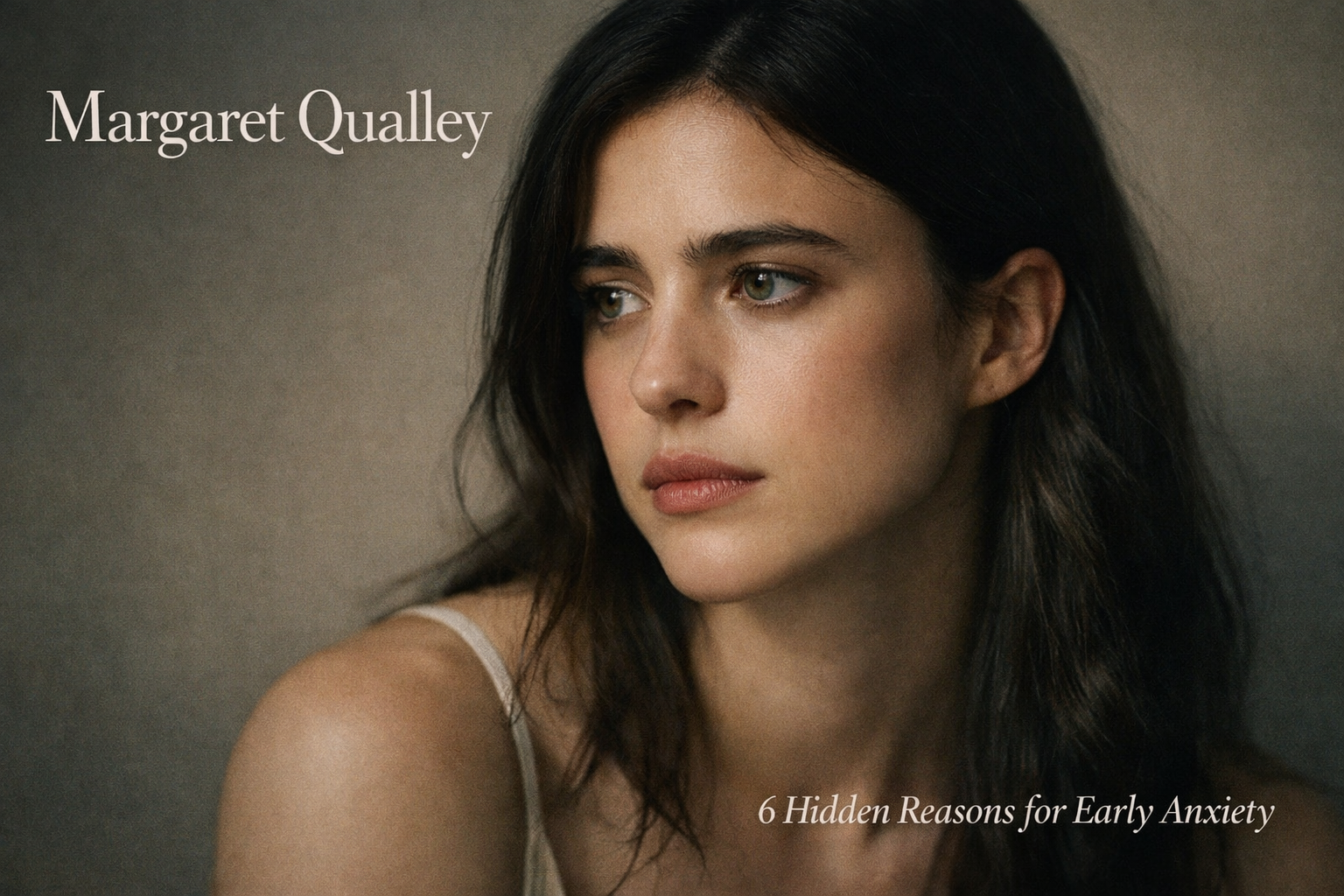
Margaret Qualley entered Hollywood at a formative stage of life, when identity was still evolving and confidence was being built. Sudden attention, public scrutiny and the pressure to perform can distort perception. Early fame does not just bring opportunity. It also brings exposure, judgment and the constant feeling of being watched.
Margaret Qualley later described that vulnerable period with striking honesty. She said, “I thought women would hate me and men would hurt me.” (People, Tommy McArdle, February 12, 2026, Margaret Qualley Worried ‘Women Would Hate Me and Men Would Hurt Me’ When She Began Acting) (https://people.com/margaret-qualley-worried-women-would-hate-me-when-she-began-acting-11905549) Her words reflected anxiety shaped by visibility and gender pressure rather than literal hostility, revealing how intense early exposure can influence perception.
Table of Contents
The Psychology of Fear in Newcomers
Entering a high visibility industry can activate social threat systems in the brain. Research in social neuroscience shows that social rejection can activate brain regions linked with distress processing. Naomi Eisenberger, Matthew Lieberman and Kipling Williams reported that social exclusion was associated with activation in areas such as the dorsal anterior cingulate cortex and anterior insula in their fMRI study. (ResearchGate, Naomi I. Eisenberger, Matthew D. Lieberman, Kipling D. Williams, 2003, Does Rejection Hurt? An fMRI Study of Social Exclusion) (https://www.researchgate.net/publication/9056800_Does_Rejection_Hurt_An_fMRI_Study_of_Social_Exclusion)
This explains why fear of judgment can feel physically real. For newcomers, especially young performers, visibility magnifies perceived evaluation. The brain interprets scrutiny as potential threat even when no immediate harm exists.
You could also strengthen it with performance psychology research. Impostor phenomenon is common among high achievers entering elite spaces. Pauline Clance and Suzanne Imes first described how competent individuals often fear exposure despite achievement. (Psychotherapy: Theory, Research and Practice, Pauline R. Clance, Suzanne A. Imes, 1978, The Impostor Phenomenon in High Achieving Women: Dynamics and Therapeutic Intervention) (https://psycnet.apa.org/record/1979-30484-001)
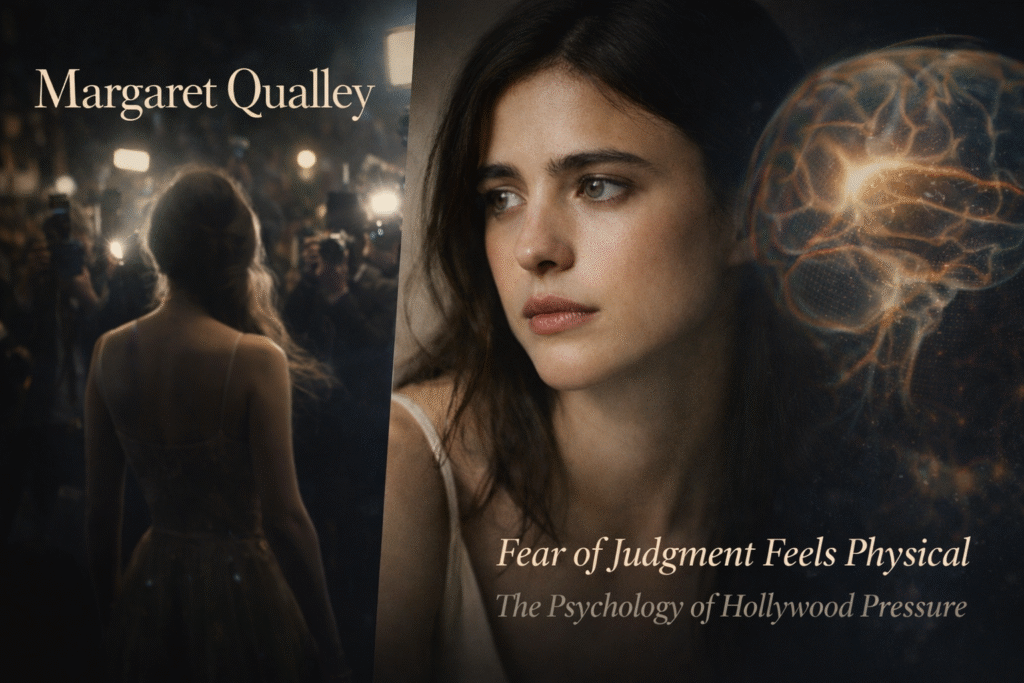
Fear in early fame rarely has a single cause. It forms through layered pressure, perception shifts and learned responses to scrutiny. To understand Margaret Qualley’s early anxiety clearly, it helps to break it into specific forces that commonly shape newcomers in high visibility industries. Here are 6 hidden reasons for early anxiety of Margaret Qualley we could identify:
1) Sudden Visibility can Activate Threat Response
When recognition rises quickly, the brain does not celebrate first. It evaluates risk. Public attention increases unpredictability and unpredictability activates vigilance. Margaret Qualley gained wider recognition through The Leftovers in 2014, a moment that placed her in front of national audiences while she was still shaping identity and confidence. Sudden visibility can distort perception because every reaction begins to feel significant.
Sudden fame often produces:
• Hyper awareness of judgment
• Anticipation of criticism
• Over interpretation of neutral reactions
• Emotional swings tied to public response
In early fame, anxiety is often a protective reflex. The mind scans for threat even when none is present. Visibility can feel less like opportunity and more like standing unshielded under intense light.
2) Gender Narratives Inside Hollywood
Entertainment culture has historically framed women through comparison and scarcity. Fewer leading roles, stricter beauty standards and age bias reinforce the perception that success is limited. A long running industry analysis from the USC Annenberg Inclusion Initiative documents persistent gender imbalance in speaking roles and behind the camera positions, showing how structural inequality shapes opportunity. (USC Annenberg Inclusion Initiative, Stacy L. Smith et al., January 2023, Inclusion in the Director’s Chair)(https://annenberg.usc.edu/sites/default/files/2017/04/06/MDSCI_Inclusion%20_in_the_Directors_Chair.pdf)
Media coverage can intensify this effect because women in film often face gender biased evaluation that blends criticism with appearance coded language. A large linguistic analysis of professional movie reviews found significantly higher levels of both hostile sexism and benevolent sexism when women were the first listed actor, director or writer. (PLOS One, Jad Doughman, Wael Khreich, January 29, 2025, Unveiling the gender bias curtain in movie reviews) (https://www.researchgate.net/publication/353618310_Platform_Feminism_Celebrity_Culture_and_Activism_in_the_Digital_Age)
Within such an environment, a young actress like Margaret Qualley does not enter a neutral space. She enters a structure that repeatedly signals that visibility invites comparison and that recognition can provoke rivalry narratives. Her early fear that women might hate her can be understood through this lens. It reflects how structural scarcity messaging shapes perception before any direct hostility occurs. Anxiety in this context becomes an internal response to cultural storytelling rather than a reaction to specific individuals.
3) Performance Training and Emotional Suppression
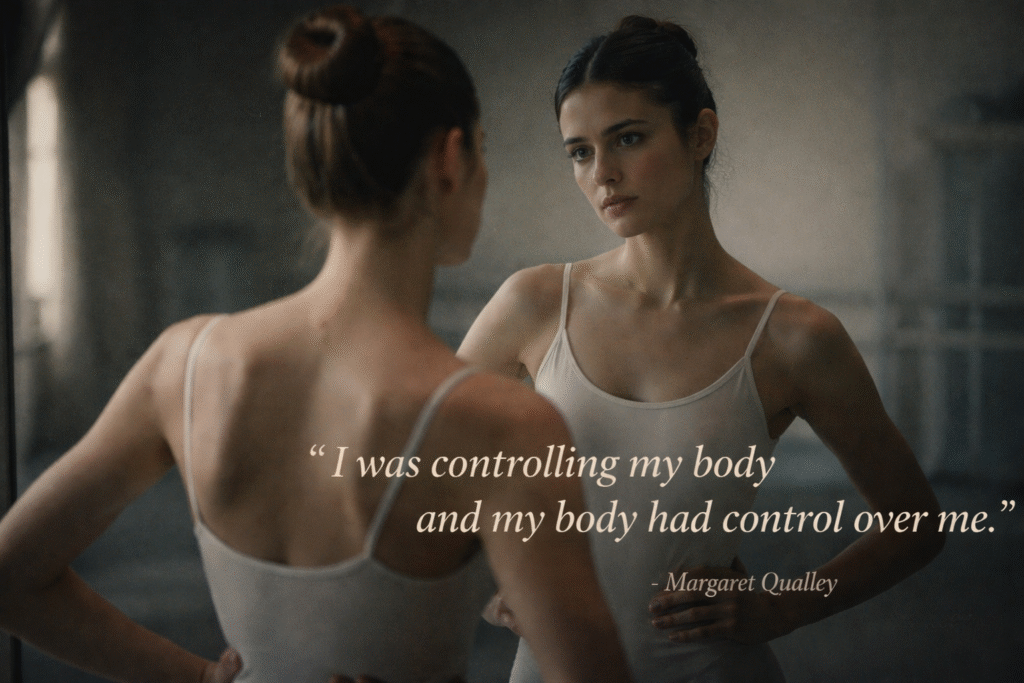
Margaret Qualley trained in ballet before acting and disciplined performance environments often reward control and endurance. That background can condition someone to override discomfort. In a later reflection she admitted, “I was controlling my body and my body had control over me.” (Vanity Fair, Marisa Meltzer, February 12, 2026, Margaret Qualley on Substance, Surrender, and Life With Jack Antonoff) (https://www.vanityfair.com/hollywood/story/margaret-qualley-cover-story) Control can become a coping strategy when the outside world feels unstable.
4) Breakthrough Success and Escalating Pressure
Career milestones do not eliminate anxiety. They can magnify it. When Maid premiered on October 1, 2021, it marked a defining moment in Margaret Qualley’s career. The series centered on resilience and vulnerability, and its release brought intense public and critical attention. The premiere date was widely confirmed ahead of launch. (TV Insider, Meredith Jacobs, August 23, 2021, ‘Maid’ Premiere Date & First Look: Margaret Qualley Portrays a Mother’s Love & Resilience (TV Insider, Meredith Jacobs, August 23, 2021, ‘Maid’ Premiere Date & First Look: Margaret Qualley Portrays a Mother’s Love & Resilience (VIDEO)) (https://www.tvinsider.com/gallery/maid-margaret-qualley-premiere-date-trailer-netflix/) Margaret Qualley moved from rising performer to central figure in a globally streamed narrative and that shift increased both visibility and expectation.
For Margaret Qualley, breakthrough success meant deeper emotional exposure as well as broader audience reach. Praise, awards buzz and media focus can intensify self scrutiny rather than calm it. When a performance becomes widely discussed, the fear of being misread or falling short can grow. Increased visibility often heightens fear of judgment because success raises the stakes of every future role.
5) Public Scrutiny and Identity Formation
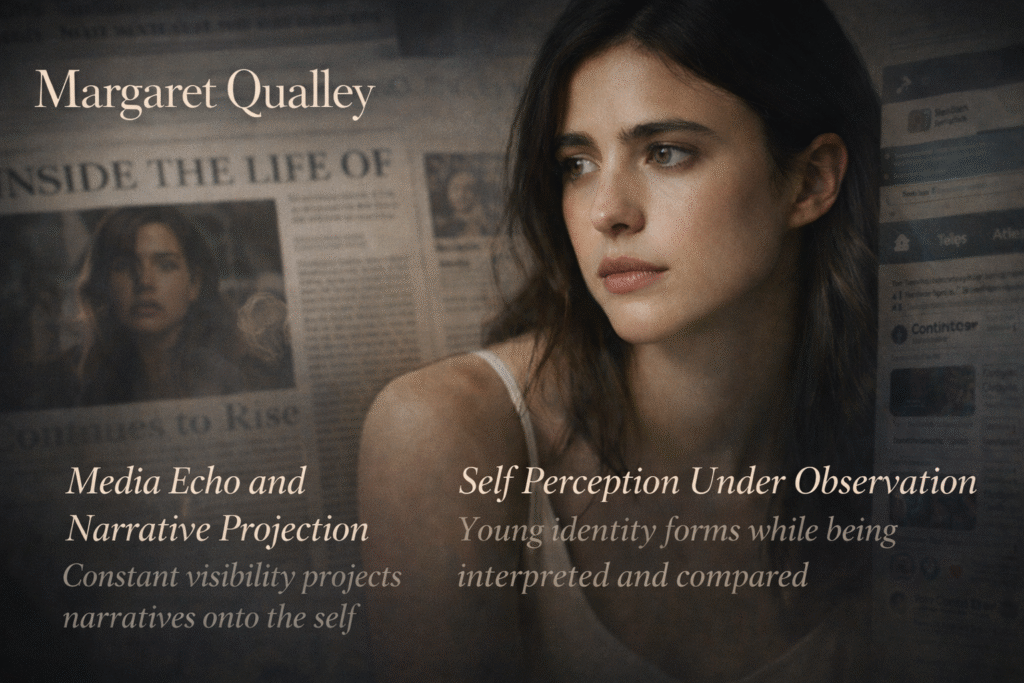
Early adulthood is already a period of identity construction. When that process unfolds in public view, self perception becomes entangled with commentary. For Margaret Qualley, early fame meant shaping adulthood while headlines, interviews and social media reactions were unfolding in real time. Public identity began forming alongside personal identity and the two do not always move at the same speed.
a. Media Echo and Narrative Projection
Digital culture amplifies speculation. A single interview answer can circulate for weeks. A facial expression can be interpreted beyond intention. Margaret Qualley entered this environment at a stage when confidence was still developing. Constant visibility can create a feedback loop where external narratives begin influencing internal self assessment.
b. Self Perception Under Observation
When a young actor feels observed, even neutral reactions can feel loaded with meaning. Anxiety can grow from imagined narratives about how others perceive you. Margaret Qualley’s early fear can be understood within this context. It reflects the strain of constructing identity while being publicly interpreted, compared and evaluated at the same time.
6) Growth Through Stability and Perspective
Over time experience builds context. Early fear often reflects unfamiliar terrain rather than permanent insecurity. As relationships deepen and career confidence solidifies, perceived threats lose intensity. The brain recalibrates once patterns become predictable.
For Margaret Qualley, later reflections show awareness rather than alarm. The fear she once described now appears as a response to early exposure rather than an ongoing crisis. With major roles behind her and personal stability shaping her life, visibility no longer carries the same unpredictability it once did. Stability reduces hyper vigilance. Confidence reframes attention as opportunity rather than danger.
Conclusion
Margaret Qualley’s early anxiety reflects a broader pattern within celebrity culture. Visibility can intensify insecurity. Gender pressure can distort expectations. Performance discipline can mask vulnerability. Her honesty adds nuance to conversations about fame and mental health. Fear in early exposure is not weakness. It is often the mind trying to survive an unfamiliar spotlight.






[…] Research on anxiety and emotional dysregulation shows that heightened emotional arousal is not the same as secure attachment or meaningful connection. Some people with anxiety experience rapid mood shifts, fear of abandonment and intense reactions that feel powerful but are rooted in stress responses rather than stability. Kocean24 has explored how anxiety can get misread as passion or depth when what is really present is emotional reactivity and fear driving behavior (Margaret Qualley: 6 Hidden Reasons Early Anxiety Could Shape a Person’s Choices, Kocean24). (https://kocean24.com/margaret-qualley-6-hidden-reasons-early-anxiety/) […]
[…] This idea connects to patterns seen in anxiety research where avoidance increases when people focus on uncertainty. Internal analysis on performance anxiety shows that overthinking first steps feeds hesitation and keeps people stuck in planning mode instead of acting mode. This section of the article highlights how beginning with a concrete first action can interrupt that cycle and initiate movement. (Margaret Qualley: 6 Hidden Reasons for Her Early Anxiety) (https://kocean24.com/margaret-qualley-6-hidden-reasons-early-anxiety/) […]