


Procrastination often begins as harmless delay. Initially it feels productive because effort appears visible, yet real progress remains absent. Preparation increases while outcomes stay unchanged. Those who act gain measurable growth, while hesitation quietly reduces confidence and results. Procrastination slowly blocks momentum without obvious warning. This article explains how to overcome procrastination and transform intention into consistent forward movement.
Table of Contents
Defining Procrastination
Psychologists describe this pattern very clearly. It is not simple delay. It is postponing something important even when you know it may hurt you later.
The Association for Psychological Science explains it as “the voluntary delay of some important task that we intend to do, despite knowing that we’ll suffer as a result.” (Association for Psychological Science, Eric Jaffe, March 29, 2013, Why Wait? The Science Behind Procrastination) (https://www.psychologicalscience.org/observer/why-wait-the-science-behind-procrastination)
The American Psychological Association adds precision. “Procrastination is not waiting and it is more than delaying. It is a decision to not act.” (American Psychological Association, April 5, 2010, Psychology of procrastination: Why people put off important tasks) (https://www.apa.org/news/press/releases/2010/04/procrastination)
Researchers also connect this behavior to emotional coping. “Procrastination has a great deal to do with short term mood repair and emotion regulation.” (White Rose Research Online, February 1, 2013, Procrastination and the Priority of Short Term Mood Regulation: Consequences for Future Self) (https://eprints.whiterose.ac.uk/id/eprint/91793/)
In short, this habit is less about poor scheduling and more about managing uncomfortable feelings.

Now let us get into the 7 brutal truths. Not to shame anyone. This is for clarity. Clarity is self respect.
1. It is an Emotion Problem
Most advice attacks delay with tools and systems. Yet the real issue is often emotional discomfort, not poor planning. Anxiety about performance, fear of failure, boredom and self doubt quietly drive avoidance.
The APA makes this clear by stating, “Procrastination is not waiting and it is more than delaying. It is a decision to not act.” (American Psychological Association, April 5, 2010, Psychology of procrastination: Why people put off important tasks) (https://www.apa.org/news/press/releases/2010/04/procrastination)
When a task threatens identity or confidence, avoidance feels like protection. Addressing the emotion behind the hesitation is the real starting point for change.
2. Short Relief Becomes Long Stress
Delaying work reduces stress in the moment. That is why it feels rewarding, but the relief is temporary.
Research summarized by APS shows that people who delay tasks may feel less stressed early on but experience higher stress and worse outcomes later. (Association for Psychological Science, Eric Jaffe, March 29, 2013, Why Wait? The Science Behind Procrastination) (https://www.psychologicalscience.org/observer/why-wait-the-science-behind-procrastination)
The pressure does not disappear. It shifts forward. Choosing a small discomfort now often prevents a much larger one later.
3. The Start Line is the Real Barrier
Most people think staying consistent is the hardest part. Research and real experience show it is starting that creates the biggest block. When a task looks large or undefined, the brain interprets it as risk. That leads to hesitation instead of action.
Clarity reduces resistance because a clear first move makes the problem feel real and manageable. The initial step does not need to be perfect or large. It only needs to be visible and specific. For example, if the goal is to write ten pages, the first meaningful action is opening the document and writing one rough sentence. That single move signals to the nervous system that progress has begun, which lowers mental friction and creates forward momentum.
This idea connects to patterns seen in anxiety research where avoidance increases when people focus on uncertainty. Internal analysis on performance anxiety shows that overthinking first steps feeds hesitation and keeps people stuck in planning mode instead of acting mode. This section of the article highlights how beginning with a concrete first action can interrupt that cycle and initiate movement. (Margaret Qualley: 6 Hidden Reasons for Her Early Anxiety) (https://kocean24.com/margaret-qualley-6-hidden-reasons-early-anxiety/)
Shrinking an intimidating task into an obvious first step turns hesitation into movement and makes real progress possible.
4. Avoidance Protects Identity
Delay can act as a shield. If you never begin, you never test your abilities. The idea remains perfect in your imagination.
APS highlights that this pattern is not mainly about poor time use. “It really has nothing to do with time management.” (Association for Psychological Science, Eric Jaffe, March 29, 2013, Why Wait? The Science Behind Procrastination) (https://www.psychologicalscience.org/observer/why-wait-the-science-behind-procrastination)
Taking action risks imperfection. Avoiding action preserves ego comfort. Growth requires accepting early flaws as part of development.

5. There are Real Well Being Consequences
This pattern is not just about missed deadlines. It can influence overall mental health.
A large German community study found links between delaying important tasks and higher stress, depression, anxiety, fatigue and reduced life satisfaction. (PLOS ONE, Manfred E Beutel, January 12, 2016, Procrastination, Distress and Life Satisfaction across the Age Range A German Representative Community Study) (https://pmc.ncbi.nlm.nih.gov/articles/PMC4752450/)
While this does not prove direct causation in every case, it shows a consistent relationship between avoidance patterns and lower well being.
Reducing delay can therefore improve both productivity and emotional stability.
6. Present Comfort Often Wins Over Future Goals
Research on mood regulation reveals an important conflict. “We prioritize our current mood over the consequences of our inaction for our future self.” (White Rose Research Online, February 1, 2013, Procrastination and the Priority of Short Term Mood Regulation: Consequences for Future Self) (https://eprints.whiterose.ac.uk/id/eprint/91793/)
In simple terms, immediate comfort feels more urgent than distant benefit. The mind protects how you feel now even if tomorrow becomes harder.
One practical strategy is to visualize the future result clearly. Ask what one small action today would make tomorrow easier. That shift reconnects present behavior with long term rewards.
7. Chronic Delay Becomes Identity
Occasional postponement is normal. Chronic patterns are different.
APS notes that research suggests as many as 20% of people may struggle with persistent forms of this behavior. (Association for Psychological Science, Eric Jaffe, March 29, 2013, Why Wait? The Science Behind Procrastination) (https://www.psychologicalscience.org/observer/why-wait-the-science-behind-procrastination)
When delay becomes part of self perception, it shapes confidence and expectations. Breaking that cycle requires repetition rather than intensity.
Small daily starts rebuild identity. Open the file. Set a short timer. Begin without judging quality. Consistency rewires habit.
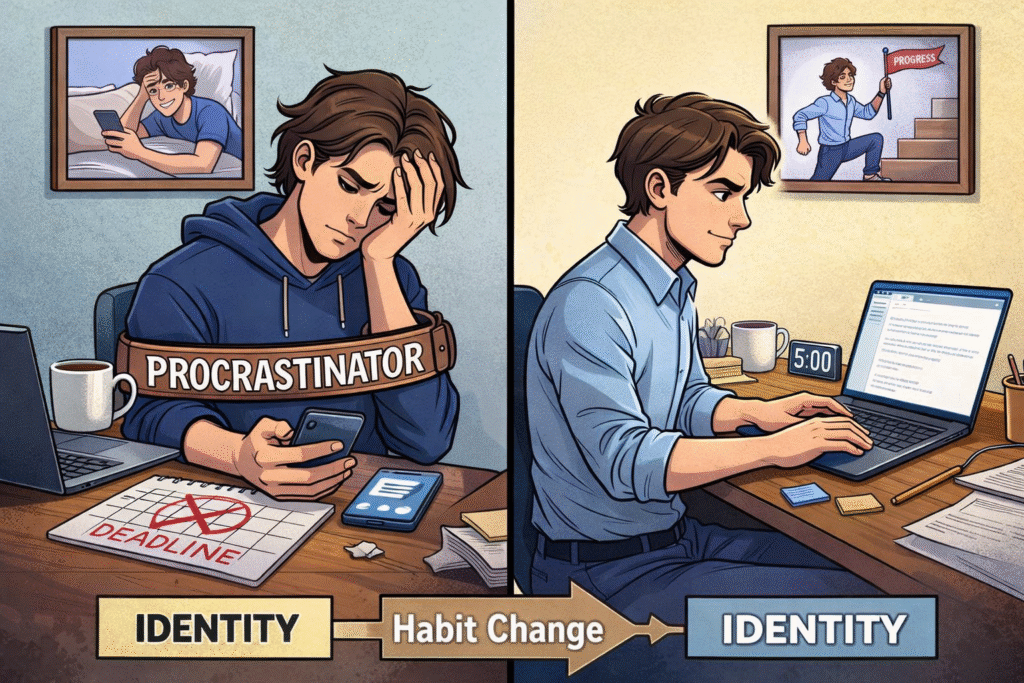
Turning Insight into Action
Avoidance grows in overwhelm and perfectionism, yet it weakens when tasks become clear and specific. Large undefined goals create mental resistance, while smaller visible actions reduce hesitation and increase follow through. Progress begins when complexity is reduced and execution becomes concrete rather than emotional.
Practical Reset Framework:
a. Clarity First
Define the task in one precise sentence so the brain knows exactly what must be done. Ambiguity increases delay, while specificity reduces friction.
b. Shrink the Entry Point
Cut the first step until it feels manageable. Opening a document, drafting one paragraph, or sending one message lowers resistance and builds initial momentum.
c. Act Before Motivation Peaks
Waiting for strong feelings delays progress. Consistent small action creates confidence, and confidence strengthens future discipline.
Final Words…
Procrastination is not proof of laziness or failure. It is a human response to emotional discomfort and uncertainty. Understanding its roots changes how you respond to it. Instead of attacking yourself, address the feeling behind the delay. Instead of waiting for confidence, build it through small action. Progress does not demand dramatic transformation. It begins with a modest, imperfect start and grows through steady repetition.






[…] Start small and measurable. A screen fast during the first hour of the morning. Five minutes of focused prayer. A weekly act of generosity that costs time rather than comfort. Silence during meals. Refusal to engage in gossip. Consistent action weakens procrastination patterns and strengthens follow through, a theme explored in Procrastination 7 Brutal Truths Killing Progress (https://kocean24.com/procrastination-7-brutal-truths-killing-progress/). […]