

Global Politics in 2026 is not just about elections or diplomatic speeches. It is about structural pressure building across economies, security alliances, institutions and technology systems. Power is shifting. Trust is thinning. Competition is intensifying. So, the question of Global Politics in 2026 is getting utmost importance.
From Washington to Brussels, from Beijing to emerging democracies, governments are operating in a world where economic tools double as weapons and technology shapes political leverage. These 7 powerful challenges are defining the global landscape.
Table of Contents
1. Geo-economic Confrontation is Becoming the Norm
Economic policy is no longer neutral in Global Politics in 2026. Trade restrictions, supply chain control and sanctions are strategic instruments. The World Economic Forum warns that “geo-economic confrontation” is now among the most significant global risks shaping the year. (World Economic Forum, January 14, 2026, Global Risks Report 2026: Geopolitical and Economic Risks Rise in New Age of Competition) (https://www.weforum.org/press/2026/01/global-risks-report-2026-geopolitical-and-economic-risks-rise-in-new-age-of-competition/?gad_source=1&gad_campaignid=22228224717&gclid=Cj0KCQiAqeDMBhDcARIsAJEbU9ShPGlQ8OEbQJ-2gKzVFvOycOBvplDmJurlgXS2DHh7WDHjQ3HdcjAaAoBnEALw_wcB))
This means tariffs and export bans are not temporary reactions. They are long-term strategic tools. The United States and China continue to compete in semiconductor control and industrial dominance. The European Union is tightening economic security measures.
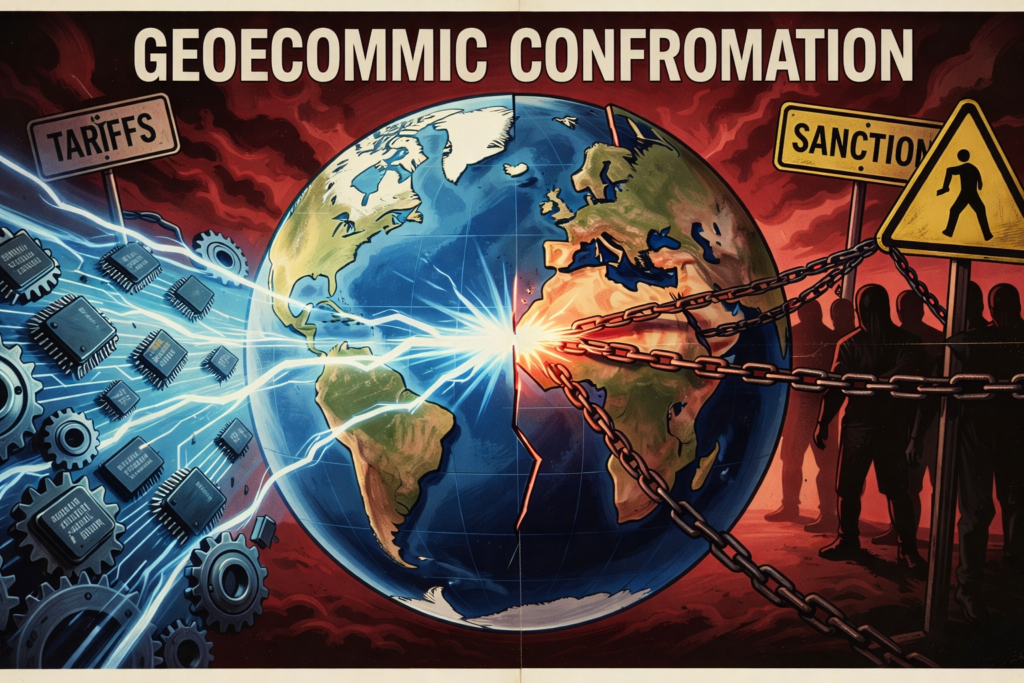
Economic fragmentation is not theory anymore. It is policy. To understand how deep this shift runs in Global Politics in 2026, consider the following structural patterns:
• Semiconductor Export Controls
Advanced chip restrictions are directly tied to national security strategy. Access to high-end processors now determines AI capability, military modernization and economic competitiveness.
• Supply Chain Realignment
Nations are reducing dependency on single country sourcing. Strategic industries such as rare earth minerals, battery production and pharmaceuticals are being reshored or diversified.
• Sanctions as Long Term Strategy
Financial sanctions are increasingly embedded into foreign policy doctrine. They reshape currency flows, payment systems and trade partnerships beyond immediate crises.
• Industrial Policy Revival
Major economies are investing heavily in domestic manufacturing through subsidies and protection measures. This marks a shift away from pure free market globalization toward strategic state backed development.
• Energy and Resource Security
Energy routes and critical mineral access are being treated as geopolitical leverage points. Control over lithium, cobalt and energy transit corridors is now directly linked to power projection.
The consequence is clear. Markets are being reorganized around strategic blocs rather than efficiency alone. Cooperation is more conditional. Competition is more systemic.
In Global Politics in 2026, economic confrontation is no longer a side effect of rivalry. It is the main arena where power is exercised.
2. The Evolving Global Order is Accelerating
Power is spreading across regions. It is no longer concentrated in one dominant bloc. Strategic analysts describe 2026 as a period where geopolitical shifts are redefining alliances and diplomatic engagement patterns across Latin America, Europe and Asia. (Lazard, January 12, 2026, Top Geopolitical Trends in 2026) (https://www.lazard.com/research-insights/top-geopolitical-trends-in-2026))
The United States remains influential. China continues expanding its global reach. India is rising as a strategic bridge. Middle powers are negotiating new positions.
A more balanced global power structure creates fresh opportunities for cooperation and regional leadership, giving emerging and middle powers greater influence. However, this broader distribution of influence also increases complexity, as more actors bring overlapping interests, slower coordination and higher chances of strategic friction in Global Politics in 2026.
3. International Rules are Weakening
The so called rules based order is under sustained pressure as multilateral cooperation shrinks across trade, security and diplomacy, and risk analysts warn of a growing “no rules world” dynamic in which global institutions struggle to enforce standards consistently. (Control Risks, No Rules World | Top Risks | RiskMap 2026) (https://www.controlrisks.com/riskmap/top-risks/the-new-rules-no-rules-world)) Trade disputes increasingly bypass global forums, security alliances are being recalibrated around national interest, and diplomatic trust is thinner than it was a decade ago, making coordination slower and enforcement uneven in Global Politics in 2026. This erosion is visible across three structural areas:
Trade Mechanisms Under Strain
Major economies are prioritizing bilateral deals and strategic blocs over universal trade frameworks, reducing the authority of global arbitration systems and weakening predictability for emerging markets.
Security Architecture in Transition
Defense partnerships are being reshaped around shifting threat perceptions, with countries strengthening regional coalitions rather than relying solely on long established multilateral security guarantees.
Diplomatic Trust Deficit
Repeated breaches of agreements and inconsistent enforcement of norms have lowered confidence in international commitments, increasing reliance on deterrence and leverage instead of shared rules.
When institutional authority weakens, influence is measured less by consensus and more by capacity and stability becomes increasingly dependent on power balance rather than shared obligation.
4. Regional Conflicts are Lingering
Global Politics in 2026 cannot detach itself from unresolved wars and persistent regional instability. The International Crisis Group identifies ongoing conflicts in Ukraine, Sudan, Myanmar and escalating tensions in the Middle East as critical flashpoints shaping the year. (International Crisis Group, December 31, 2025, 10 Conflicts to Watch in 2026) (https://www.crisisgroup.org/cmt/global/10-conflicts-watch-2026))
These crises are deeply interconnected with the global system. They disrupt energy supply chains, influence commodity prices, accelerate refugee flows and reshape defense spending priorities. Military aid decisions affect diplomatic alignments. Sanctions regimes alter trade routes. Security guarantees tighten or fracture depending on battlefield developments.
The longer these conflicts endure, the more they harden political positions and erode trust among major powers. In Global Politics in 2026, unresolved wars are not background noise. They are structural forces that shape economic stability, alliance cohesion and diplomatic momentum worldwide.
5. Technology is Reshaping Political Power
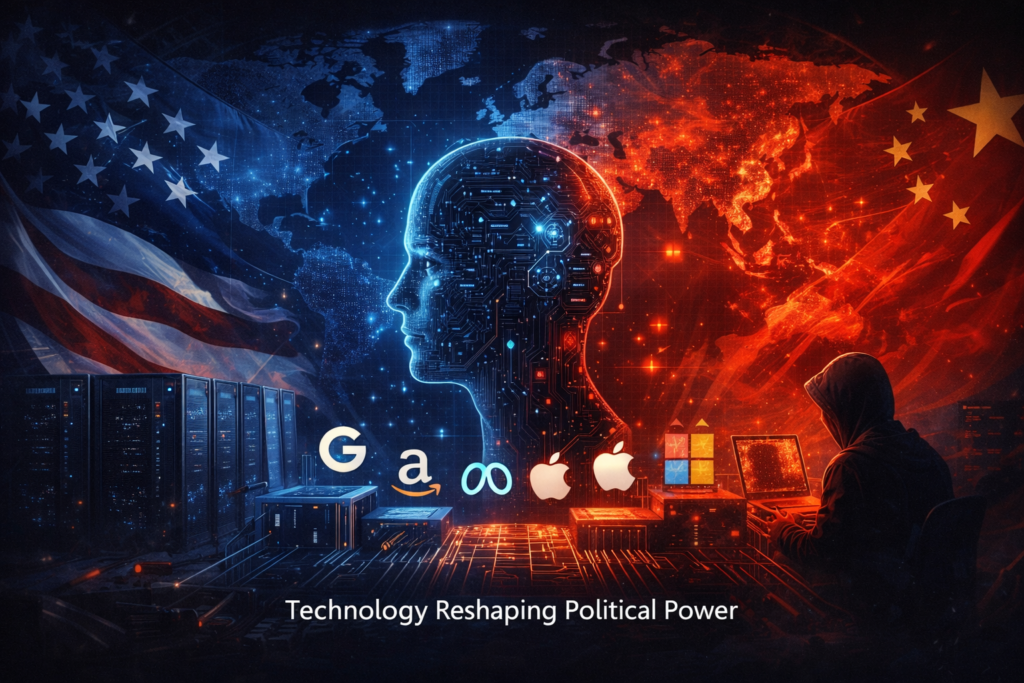
Artificial intelligence, digital surveillance and cybersecurity are no longer peripheral tools of governance. They are central pillars of strategic power. Political analysts observe that frontier technologies will redefine economic and geopolitical competition in 2026, influencing everything from industrial capacity to military planning. (World Politics Review, December 26, 2025, WPR’s Columnists on What to Expect in 2026: Part 1) (https://www.worldpoliticsreview.com/global-2026-trends-preview/)
Governments are integrating AI into defense logistics, predictive analytics and administrative systems, while private technology giants such as Microsoft, Google, Amazon, Apple and Meta increasingly sit at the intersection of policy, infrastructure and influence. The competition for semiconductor dominance, cloud infrastructure and data sovereignty is tightening, particularly between the United States and China. In Global Politics in 2026, technological capability is directly tied to diplomatic leverage and economic resilience.
This transformation is visible across three strategic dimensions:
Artificial Intelligence and Political Messaging
AI tools are shaping campaign strategies, public communication and voter targeting, enabling faster narrative control and more personalized persuasion at scale. Governments are also deploying AI for policy modeling and national security forecasting, altering decision making speed and precision.
Cyber Operations and Digital Deterrence
Cyber capabilities now function as instruments of statecraft. Offensive and defensive cyber operations influence diplomatic negotiations, infrastructure protection and crisis response strategies, creating a digital layer beneath traditional military deterrence.
Data Sovereignty and Platform Influence
Control over data flows, cloud infrastructure and digital platforms determines national competitiveness in Global Politics in 2026. Debates over data localization, content moderation and cross border information regulation are redefining how states interact with global technology firms and with each other, shaping digital authority as a core dimension of strategic power.
Technology is no longer simply innovation infrastructure. It is political infrastructure.
6. Institutional Legitimacy is Under Strain
Public trust in institutions is eroding across multiple democracies and governance credibility is becoming a central political battleground in Global Politics in 2026. Courts, regulatory agencies and oversight bodies are increasingly drawn into partisan conflict, with citizens questioning whether rules are applied evenly or selectively. When institutional neutrality is doubted, policy decisions are viewed through ideological lenses rather than civic consensus.
Transparency International’s global corruption analysis highlights how enforcement inconsistencies and political shielding are damaging accountability norms. (The Guardian, February 20, 2026, Corruption is no longer envelopes of cash – now it is about who Washington is shielding and who it is sacrificing) (https://www.theguardian.com/global-development/2026/feb/20/corruption-perceptions-index-transparency-international-us-trump-world-bribery-governance-sanctions)) Such perceptions weaken confidence in anti corruption mechanisms and reinforce the belief that power determines protection. When oversight appears uneven, democratic legitimacy suffers and public frustration intensifies.
As citizens question fairness and transparency, polarization deepens and political narratives become sharper across Global Politics in 2026. Institutional weakness fuels populism and nationalist rhetoric across continents, encouraging leaders to bypass established procedures in favor of executive assertiveness. In this environment, stability depends not only on law but on whether the public believes the law is applied without favoritism.
7. Election Cycles Are Reshaping Stability
Elections in 2026 are not routine democratic exercises. They are global stress tests that shape economic confidence, alliance direction and diplomatic tone. In an interconnected system, leadership transitions rarely stay domestic. Markets react instantly. Investors reassess risk. Foreign governments recalibrate expectations. In Global Politics in 2026, electoral cycles function as geopolitical turning points rather than internal administrative processes.
Political transitions often amplify economic anxiety and foreign policy uncertainty. Campaign rhetoric influences currency movements, defense commitments and trade negotiations even before ballots are cast. Domestic electoral movements now influence international positioning because policy continuity can no longer be assumed. Kocean24’s electoral analysis illustrates how preparation phases alone can reshape political alignment and strategic messaging. (Kocean24, Bangladesh Election 2026: 5 Powerful Signals for South Asia) (https://kocean24.com/bangladesh-election-2026/)) This reflects a broader structural reality in which election dynamics extend beyond borders and signal potential policy recalibration.
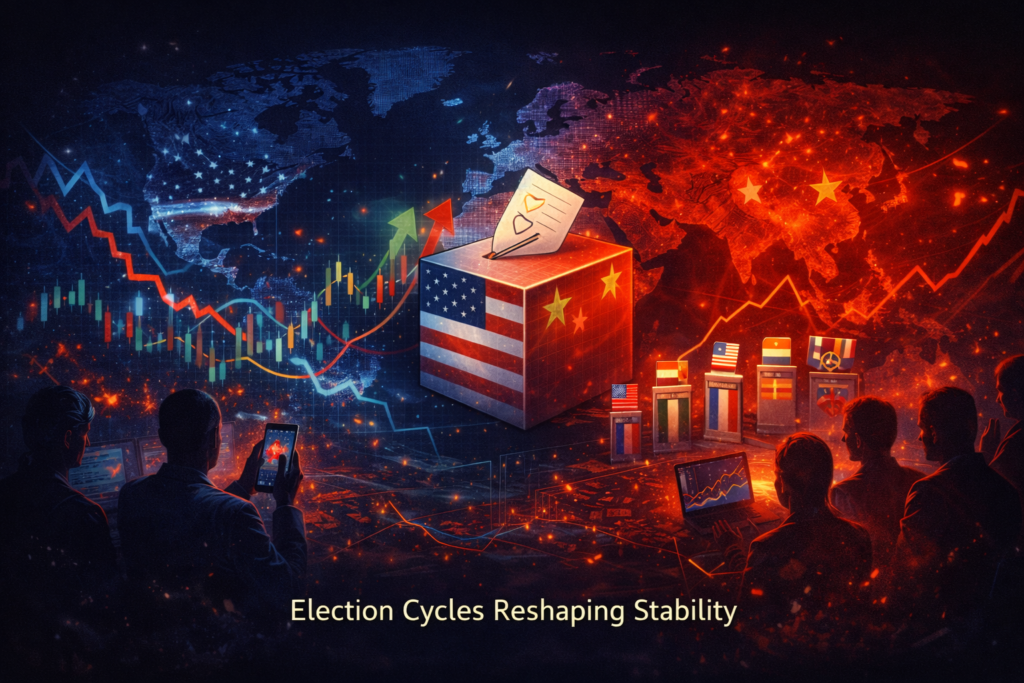
The lesson is systemic rather than country specific in Global Politics in 2026. Ballots influence sanctions frameworks, climate commitments, technology regulation and security guarantees. Political transitions in America, Europe, Asia and emerging democracies will define alliance durability and economic direction through:
• Trade and tariff policy adjustments
• Defense and security partnership commitments
• Climate and energy transition priorities
• Technology governance and data regulation
• Sanctions alignment and diplomatic posture
In 2026, electoral outcomes are not isolated political events. They are global ripple moments capable of stabilizing cooperation or accelerating fragmentation.
Conclusion
Global Politics in 2026 faces structural tension shaped by economic confrontation, evolving alliances, weakened norms, persistent conflicts, technological rivalry, institutional strain and decisive election cycles. These powerful challenges reveal a world recalibrating its balance of influence rather than collapsing into disorder. Stability will depend on strategic adaptation, credible governance and responsible leadership across continents. The year ahead is not only uncertain but transformative. Stay informed with deeper global insight.

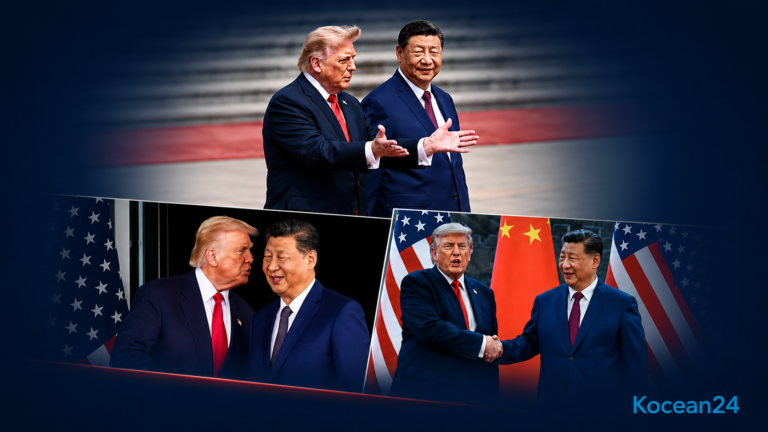



[…] As a result, the summit was never only about diplomacy or trade tariffs. The Taiwan issue also represented a struggle over chip access, AI leadership, industrial resilience and long term strategic influence. Kocean24 has already explained that technology is becoming political infrastructure in 2026 as semiconductor control, AI systems and data dominance increasingly shape global power competition. (Kocean24, February 21, 2026, Global Politics in 2026: 7 Powerful Challenges Ahead) (https://kocean24.com/global-politics-in-2026-7-powerful-challenges-ahead/) […]