Physical Address
304 North Cardinal St.
Dorchester Center, MA 02124
Physical Address
304 North Cardinal St.
Dorchester Center, MA 02124

Ancient Lessons still matter because success has never been only about speed, money, talent, or public attention. Every generation changes its tools, but human struggle stays familiar. People still fight fear, laziness, distraction, pride, pressure, and doubt. Ancient thinkers did not have social media, AI tools, online business, or creator platforms. Still, they understood the inner game better than many modern gurus. Their ideas remain useful because success starts inside the mind before it appears in public life.
Ancient success begins with the mind. Confucius is described by Stanford Encyclopedia of Philosophy as a teacher, advisor, editor, philosopher, reformer, and prophet in different historical periods. (Stanford Encyclopedia of Philosophy, Mark Csikszentmihalyi, March 31, 2020, Confucius) (https://plato.stanford.edu/entries/confucius/)
His legacy shows one simple point. A person does not become strong only by winning outside. Growth begins with self discipline, reflection, and character.
This is why the Chinese quote “There is nothing difficult in the world as long as you set your mind to it” feels so powerful. The exact wording is often shared online, but the deeper principle is older than the internet. Success starts when attention becomes focused. A scattered mind makes easy things feel heavy. A trained mind makes difficult things feel possible.
Aristotle treated ethics as a practical field because its purpose was to improve human life, not just explain ideas. (Stanford Encyclopedia of Philosophy, Richard Kraut, May 1, 2001, Aristotle’s Ethics) (https://plato.stanford.edu/entries/aristotle-ethics/)
That is one of the major ancient lessons for success. Merely knowing is not enough. Repeating the right action shapes the person.
Modern life often worships quick talent. Ancient lessons or wisdom respected practice. A writer becomes sharper by writing. A student becomes stronger by studying and a creator becomes valuable by producing even when nobody claps yet. Success is not magic. It is repeated behavior with direction.

James Clear wrote, “Habits are the compound interest of self improvement,” showing how tiny repeated actions can create major long term change. (James Clear, Atomic Habits) (https://jamesclear.com/atomic-habits) A person who writes one page a day may produce a book in a year. A creator posting consistently can build trust before popularity arrives. Ancient Lessons often return to this truth. Mastery rarely appears through one dramatic breakthrough. It grows through ordinary effort repeated until it looks extraordinary.
Stoicism was founded by Zeno of Citium in the third century BCE and became one of the major schools of ancient Greco Roman philosophy. (Encyclopaedia Britannica, April 18, 2026, Stoicism) (https://www.britannica.com/topic/Stoicism)
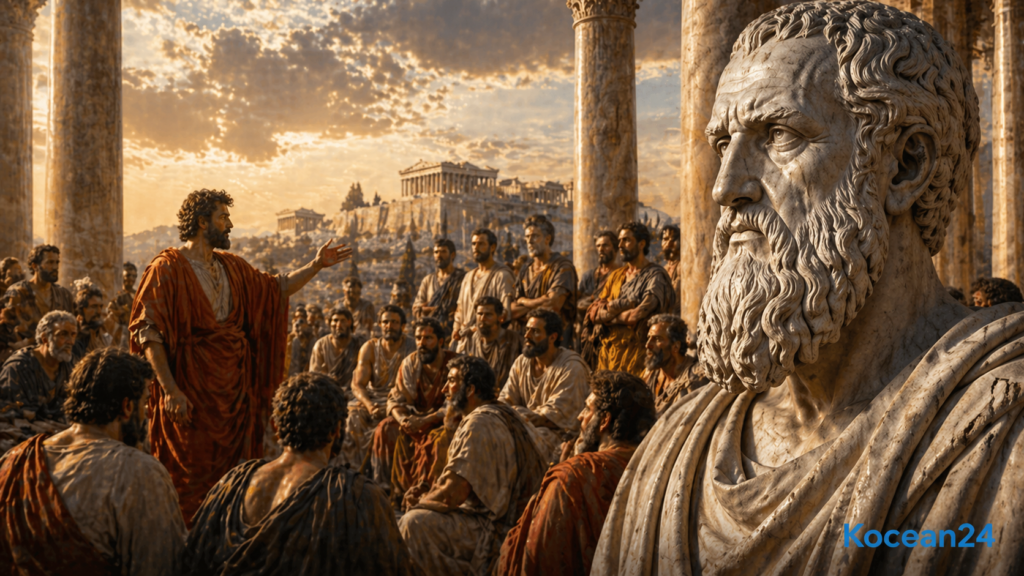
Its strongest modern lesson is simple. Control your response before trying to control the world.
A person cannot control every market, algorithm, comment, rejection, or delay. But they can control effort, preparation, attitude, learning, and recovery. This is not passive thinking. You can term it as strategic thinking. Energy wasted on uncontrollable things weakens progress. Energy placed on action creates movement.
Stanford Teaching Commons explains growth mindset as the belief that intelligence can expand and develop. (Stanford Teaching Commons, Growth Mindset and Enhanced Learning) (https://teachingcommons.stanford.edu/teaching-guides/foundations-course-design/learning-activities/growth-mindset-and-enhanced-learning)
This connects beautifully with Ancient Lessons because old wisdom never treated struggle as proof of failure. It treated struggle as part of formation.
The modern trap is personalizing every setback. One rejected pitch becomes “I am not good enough.” A failed post becomes “This niche is dead.” and a bad exam becomes “I cannot do it.” Ancient wisdom would challenge that weakness. A setback is information. It does not define the full person, rather shows what needs repair.
Angela Duckworth and her coauthors defined grit as perseverance and passion for long term goals. (Journal of Personality and Social Psychology, Angela L. Duckworth, Christopher Peterson, Michael D. Matthews and Dennis R. Kelly, 2007, Grit: perseverance and passion for long-term goals) (https://pubmed.ncbi.nlm.nih.gov/17547490/) Their insight reinforces what many Ancient Lessons have taught for centuries. Lasting success often belongs to people who keep going when excitement fades. Talent may open a door, but persistence keeps a person moving through setbacks, boredom, and slow seasons of growth.
This matters in modern life because many people confuse intensity with endurance. They start strong, but struggle to stay steady. Grit is different. It is quiet commitment. It keeps a creator publishing when views are low. Ancient Lessons often return to this same truth. Great outcomes are rarely won through one dramatic effort. They are built through faithful work repeated across months and years until ordinary discipline produces extraordinary results.

Harvard Health Publishing explains that aerobic exercise can reduce stress hormones and stimulate endorphins, which can support relaxation and optimism. (Harvard Health Publishing, July 7, 2020, Exercising to relax) (https://www.health.harvard.edu/healthy-aging-and-longevity/exercising-to-relax)
This matters because success is not only mental. The body carries the pressure of ambition.
Ancient traditions often connected discipline with daily physical order. Sleep, movement, breathing, and routine are not small things. They protect focus. The person who manages energy usually lasts longer than the person who only chases motivation.
Ancient Greek training offers a strong example here. The Greeks did not separate physical discipline from intellectual excellence. In places such as the gymnasium, exercise, philosophy, and civic learning often existed side by side. A resilient body can strengthen judgment, patience, and endurance. This reflects what ancient lessons often teach. Physical discipline was seen as part of preparing the whole person, not just training muscles. A similar idea appears in our reflection on discipline and inner formation in (Kocean24, Ash Wednesday: 5 Powerful Reasons It Still Matters in 2026) (https://kocean24.com/ash-wednesday-5-powerful-reasons-still-matters-2026/).
Spartan training offers another striking example. Spartan culture valued endurance, restraint, and disciplined conditioning as foundations of strength and resilience. The system was built to develop toughness and obedience through lifelong training. This lesson still feels modern. Energy management is not separate from success. It supports success.
This is how Ancient Lessons remind us ambition survives longer when supported by healthy rhythm. Even in old civilizations, strength of body was often treated as an ally of strength of mind.
Britannica explains virtue ethics as an approach centered on traits of character essential to human flourishing. (Encyclopaedia Britannica, April 4, 2026, Virtue ethics) (https://www.britannica.com/topic/virtue-ethics)
This is the deepest ancient lesson. Success without character is fragile. Skill can create attention, but character protects legacy.
A person with character can handle growth without losing direction. They can earn trust or recover after mistakes. They can also build slowly without becoming desperate. In business, content, study, leadership, or personal life, character is not decoration. You may term it as infrastructure.
Ancient Lessons still work because human nature has not changed much. People still need discipline, patience, focus, courage, and honest self correction. The tools are new, but the battle is old. Success does not begin when the world becomes easy. It begins when the mind becomes steady enough to keep going.