Physical Address
304 North Cardinal St.
Dorchester Center, MA 02124
Physical Address
304 North Cardinal St.
Dorchester Center, MA 02124

AI Articles are multiplying faster than most readers can process them in 2026. At first glance, the structure looks sharp and the language feels confident. Yet something feels strangely empty after a few paragraphs. Attention fades. Memory slips. One group is racing to publish faster than ever. Another group is fighting to protect credibility and depth. That tension is shaping the future of digital writing. This article explores the three harsh realities behind AI Articles and what they mean for trust, originality and long term influence online.
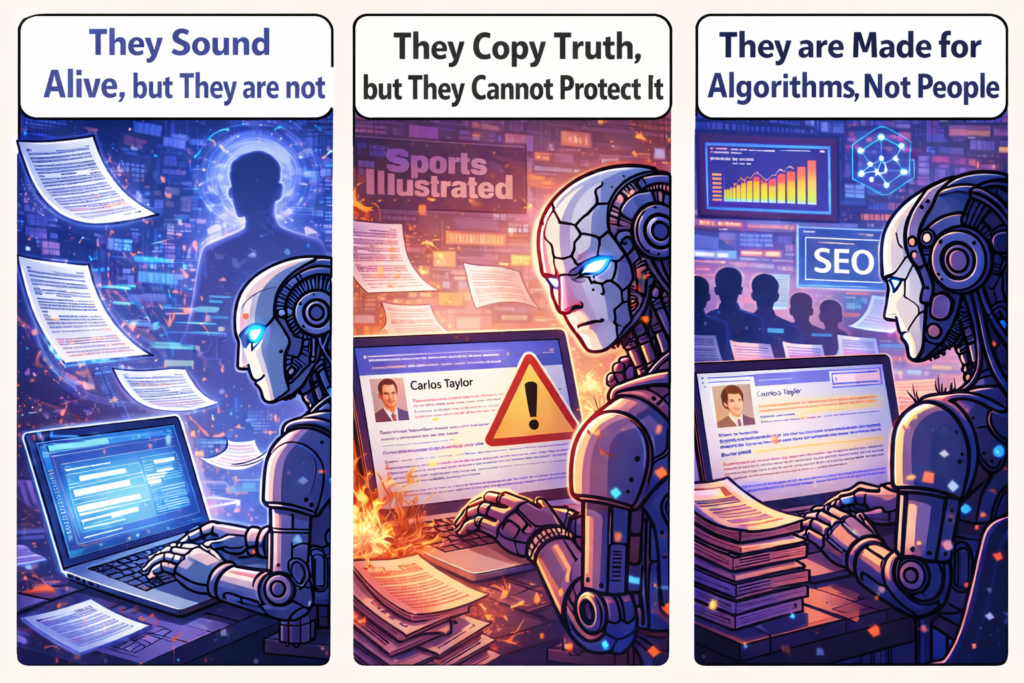
AI articles often imitate real storytelling without earning credibility. Smooth transitions flow from line to line. A polished surface creates the illusion of depth. Confidence shows up early. Yet true perspective never arrives. Lived experience stays outside the frame. The whole piece feels like a tailored coat hanging with no one inside it.
That is why “perfect grammar” does not AI articles. The rhythm is too even and the emotion is too safe. The opinion is too vague. When a reader senses this, trust drops fast. Even The Money Hacker calls out the pain point directly, saying most AI written articles can feel “unconditionally robotic.” (The Money Hacker, August 28, 2025, Running Your Blog with AI?) (https://www.moneyhacker.online/blog/posts/running-your-blog-with-ai)
The fix is not to add random slang but human decisions. Pick a stance. Use real friction. Keep a few rough edges. The Money Hacker pushes this same idea by focusing on voice choices that make AI writing feel present, not sterile. (The Money Hacker, n.a., December 12, 2025, 6 Best Ways to Humanize Your AI Written Articles) (https://www.moneyhacker.online/blog/posts/humanize-your-ai-written-article)

The most dangerous AI articles are not the bad ones. They are the smooth ones that are wrong. The reader sees clean structure and assumes accuracy. That is how fake authority wins. Not with chaos, but with calm formatting.
This is also why AI content scandals land so hard. It is not only about automation. It is about trust being traded for speed. Futurism reported Sports Illustrated publishing articles with seemingly fake bylines and the outlet deleting content after questions were asked. (Futurism, Maggie Harrison Dupré, Nov 27, 2023, Sports Illustrated Published Articles by Fake, AI Generated Writers) (https://futurism.com/sports-illustrated-ai-generated-writers)
Google’s guidance basically draws the line in the sand. It is not anti AI. Rather it is anti manipulation and low value. Google says it aims for “Rewarding high quality content, however it is produced.” (Google Search Central Blog, Danny Sullivan and Chris Nelson, February 8, 2023, Google Search’s guidance about AI generated content) (https://developers.google.com/search/blog/2023/02/google-search-and-ai-content) That sounds fair. But it also means the burden moves to the creator. If the facts are weak, the tool does not get blamed. The page does.

The web carries a different scent now. Sheer output dominates timelines. Endless recycling crowds every corner. Material appears simply because production is easy, not because value exists. Many AI articles are engineered to saturate categories, capture search phrases and climb visibility charts. This cycle sparks a relentless competition for exposure. Platforms expand. Significance shrinks.
Jason Koebler describes this dynamic as “a brute force attack on the algorithms that control the internet.” (404 Media, Jason Koebler, Mar 17, 2025, AI Slop Is a Brute Force Attack on the Algorithms That Control Reality) (https://www.404media.co/ai-slop-is-a-brute-force-attack-on-the-algorithms-that-control-reality/) That line hits because it explains the vibe people feel. The audience is not always a human anymore. The audience is the feed and the target is the ranking system. The reader becomes collateral here.
This is why people say they hate AI articles even when they cannot prove one is AI. They are reacting to a pattern. It contains the same framing, same safe advice and same filler paragraphs that never risk being wrong. It is content that refuses to be accountable, because it has no real author behind it.
AI Articles are not disappearing in 2026. They are expanding across every niche and platform. The real issue is not automation but intention. When speed replaces judgment, quality suffers. When volume replaces voice, meaning shrinks. The creators who win will not be the fastest. They will be the most deliberate, transparent and human in how they use technology. The harsh realities are clear, but so is the opportunity for those willing to write with purpose instead of pressure.