Physical Address
304 North Cardinal St.
Dorchester Center, MA 02124
Physical Address
304 North Cardinal St.
Dorchester Center, MA 02124
Canvas Cyberattack in USA schools has become a serious warning for digital education in recent days. The issue began when the hacker group ShinyHunters claimed responsibility for breaching Instructure, the company behind Canvas. Students and schools then faced blocked access, ransom messages and fears that private academic data could be leaked. The problem is with not only the school technology but also with student privacy, classroom continuity and above all with trust for every institution using cloud based learning systems.
The Canvas Cyberattack centered on Instructure, the parent company that manages Canvas for schools, colleges and universities. Reuters reported that student newspapers from Harvard, the University of Pennsylvania, Duke, UCLA and the University of Nebraska said students were blocked from Canvas and redirected to a message from ShinyHunters. (Reuters, Christian Martinez, May 8, 2026, Education tool Canvas hacked, multiple US college newspapers report) (https://www.reuters.com/technology/education-tool-canvas-hacked-multiple-us-college-newspapers-report-2026-05-08/)
That detail matters because this was not a quiet background breach. Students were seeing the threat in real time. A learning platform became a ransom stage. For schools, that changed the incident from a technical investigation into a public crisis.
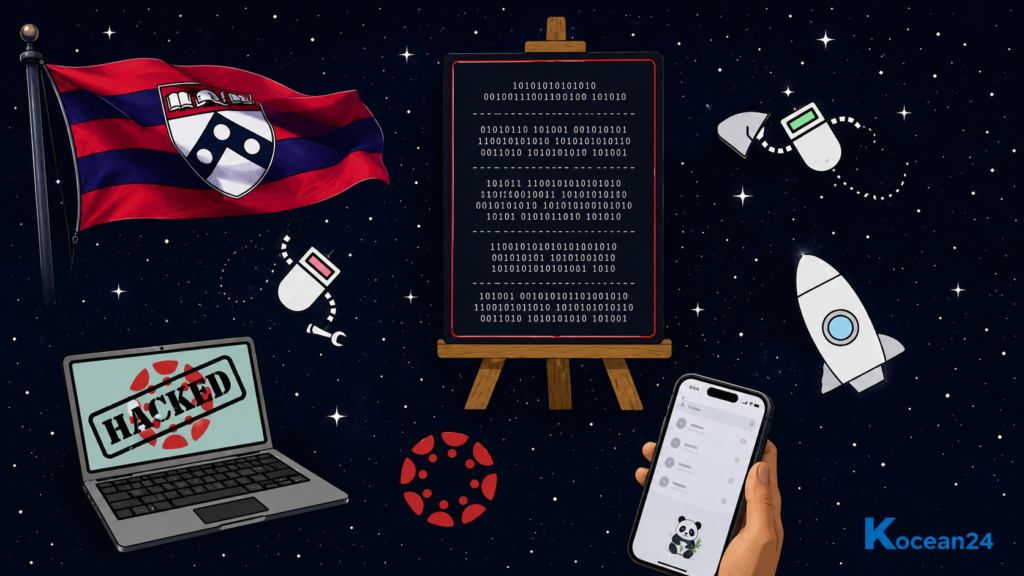
The Canvas Cyberattack also came at a painful moment. Many students were preparing for finals. Assignments, grades, study materials and course messages were inside the same system. When Canvas access stopped, academic pressure grew fast.
ShinyHunters is not an unknown name in cybercrime reporting. The group has been connected with major breach claims before. In this case, the group allegedly used the disruption to pressure Instructure and schools.
WRAL reported that ShinyHunters said it would release data it acquired through the breach unless it was paid a ransom, and the group said affected schools could negotiate before a May 12 deadline. (WRAL, Joseph Ochoa and wire reports, May 7, 2026, Hacker group disables Canvas for NC students during crucial end of school year stretch) (https://www.wral.com/news/education/canvas-shinyhunters-ransom-instructure-hack-data-breach-may-2026/)
This is the heart of the issue. The matter is very clear now. The motive of the cyber attack was not only about stealing information. Rather, it was about creating pressure. Hackers wanted fear to travel through classrooms, parent groups and university channels.
The Canvas Cyberattack shows how modern extortion works. Criminal groups do not always need to shut down every system. Sometimes they only need to create enough uncertainty to make institutions feel cornered.
The first fear after any education breach is simple. What did hackers get? In this case, the exposed data appears to involve student related information rather than financial records.
The Associated Press reported that the breach disrupted Canvas across thousands of schools and universities and that screenshots showed threats to leak stolen data unless extortion demands were met. (Associated Press, Heather Hollingsworth, May 8, 2026, Cyberattack hits Canvas system used by thousands of schools as finals loom) (https://apnews.com/article/a0d7719689263e6b5f90d0e633391b5b)
Even when passwords or bank details are not confirmed as exposed, the damage can still be real. Names, emails, student IDs and internal messages can help scammers build targeted phishing attempts. A fake school email becomes more believable when it uses real student information.
That is why the Canvas Cyberattack should not be treated as a small privacy event. Student data is personal. It connects real people to real schools, real classes and real daily routines.
Schools did not have the luxury of waiting. Once ransom messages and login issues appeared, some institutions had to block access, isolate systems or warn students.
ABC News Australia reported that hundreds of thousands of students were unable to access schoolwork or submit assessments, with some receiving ransom messages after the global cybersecurity hack. (ABC News, Ned Hammond and Liana Walker, May 8, 2026, Students receive ransom messages after learning system cyberattack) (https://www.abc.net.au/news/2026-05-08/students-lose-access-to-canvas-receive-ransom-messages/106657440)
That shows the global scale of the disruption. A platform used for simple classroom tasks suddenly became part of an international cyber incident.
The Canvas Cyberattack also exposed a hard truth. Schools can be highly prepared locally and still become vulnerable through a vendor. If one major education platform faces a breach, the ripple effect can touch thousands of institutions.
Now, let’s discuss what’s the lesson we should learn from this cyber attack:
The first future lesson from the Canvas Cyberattack is brutally clear. Most schools built digital classrooms for convenience, speed and modern learning, but many never built them for collapse. When Canvas suddenly became unstable, students did not simply lose one app. Many lost access to assignments, grades, announcements, study materials, teacher communication and exam preparation at the same time. A single platform had quietly become the nervous system of school life.
That dependence is dangerous because cyberattacks do not arrive politely. They strike during normal routines. In this case, the disruption reportedly arrived while many students were preparing for finals and major submissions. Panic spread quickly because schools, teachers and families were trying to solve problems while the system itself was under threat.
The Canvas Cyberattack showed that too many institutions still operate with a “main platform only” mindset. If the main system breaks, confusion immediately follows. Students suddenly lose access to assignment portals and class materials. Teachers struggle to send verified updates across multiple courses. Parents struggle to identify which updates are official and which are fake screenshots or rumors spreading online.
Future digital education systems must be designed with layered continuity plans. Every school should have an emergency academic communication structure outside the primary platform. That can include backup portals, emergency email systems, SMS alerts, temporary assignment pages or verified school social channels. Teachers should be trained to switch quickly during outages instead of improvising under pressure.

Schools also need cyber disruption drills in the same way they practice physical emergency drills. Before a crisis ever begins, schools should clearly explain how exams, submissions and class communication will continue during a platform outage. Families also need one verified place for emergency updates so confusion and fake information do not spread during stressful moments. Confusion becomes smaller when procedures already exist before crisis begins.
The deeper issue is psychological. Modern students have grown up inside digital systems. When the platform disappears, many feel disconnected from school itself.
The Canvas Cyberattack proved that online learning cannot depend on one fragile digital gatekeeper. If one system fails, education must still move forward without fear, silence or chaos.
Schools often protect financial data with seriousness, but student records sometimes receive less attention. That mindset must change.
The Canvas Cyberattack shows that student IDs, emails and messages can become valuable to criminals. Hackers can use them for scams, impersonation and pressure campaigns.
Every school should ask vendors clear questions. What data is stored? Who can access it? How long is it kept? What happens when a breach occurs? Strong contracts matter because trust alone is not a security plan.
Canvas is a third party platform, but students experience it as part of school life. When it fails, they do not blame vendor architecture. They feel school has failed them.
That is why vendor risk must become a board level concern. School leaders should not leave it only to IT teams. A learning platform now carries academic operations, communication and identity data.
The Canvas Cyberattack makes one thing clear. Schools must audit vendors before crisis, not after headlines.
Students need practical cyber education. Students must learn how to recognize manipulated messages, avoid panic driven rumors and verify school alerts before reacting or forwarding information to others.
Kocean24 has already reported that technology driven fields like cybersecurity and data analytics are becoming important in the modern digital workforce. (Kocean24, Fred Laxy, February 25, 2026, Freelancing Boom: A Massive 86.5 Million Americans by 2027) (https://kocean24.com/freelancing-boom-in-america-2027/)
The same logic applies inside schools. Cybersecurity is not just a future career skill. It is now a daily survival skill for students, teachers and families.
The most lasting damage may not be downtime. It may be trust. Students trust schools with their names, conversations and academic records. Parents trust schools to protect children in physical and digital spaces.
The Canvas Cyberattack damaged that trust because the threat appeared inside a learning environment. That feels personal. It makes students wonder whether their school tools are safe.
Schools can rebuild trust with honest communication. They should avoid vague updates. They also should explain what is known, what remains under investigation and what students should do next.
The Canvas Cyberattack exposed how vulnerable modern education systems can become when too much trust is placed inside a single digital structure. Schools now face a bigger responsibility than simply restoring access after an outage. They must rethink how student data is protected, how communication continues during emergencies and how learning survives when major platforms suddenly fail. Future education systems will need stronger resilience, faster response planning and clearer digital accountability because cyberattacks against schools are no longer rare incidents. They are becoming part of the modern education reality.
To reduce future disruption, schools should focus on several urgent priorities:
Every platform handling student information should face deeper security review before schools fully depend on it. Administrators should clearly understand what data is stored, who can access it and how quickly institutions will be informed during a breach.
Assignments, announcements and classroom communication should never rely on one fragile digital channel. Schools need alternative communication paths that remain active during platform outages or cyber emergencies.
Many educational systems store more information than they truly need. Limiting unnecessary records reduces long term exposure if hackers gain access to databases or internal communication systems.
Cyber awareness should become part of everyday school culture. Students and staff need practical guidance on identifying suspicious activity, verifying official updates and responding calmly during digital disruptions.
Grades, identity records, attendance systems and classroom messaging should not remain tightly connected through one vulnerable platform structure. Segmented systems can reduce the scale of damage when attacks occur.
The Canvas Cyberattack should become more than a temporary headline. It should become a turning point that pushes schools toward safer, smarter and more resilient digital education systems.
The Canvas Cyberattack started as a hacking incident, but it became something bigger. It showed how one breach can disturb classrooms, expose student information and pressure institutions during a critical academic period. The future lesson is clear. Schools need stronger vendor checks, better backup plans, clearer communication and real cyber awareness for students. Digital education can still be powerful, but it must be protected like a core part of school life.