Physical Address
304 North Cardinal St.
Dorchester Center, MA 02124
Physical Address
304 North Cardinal St.
Dorchester Center, MA 02124
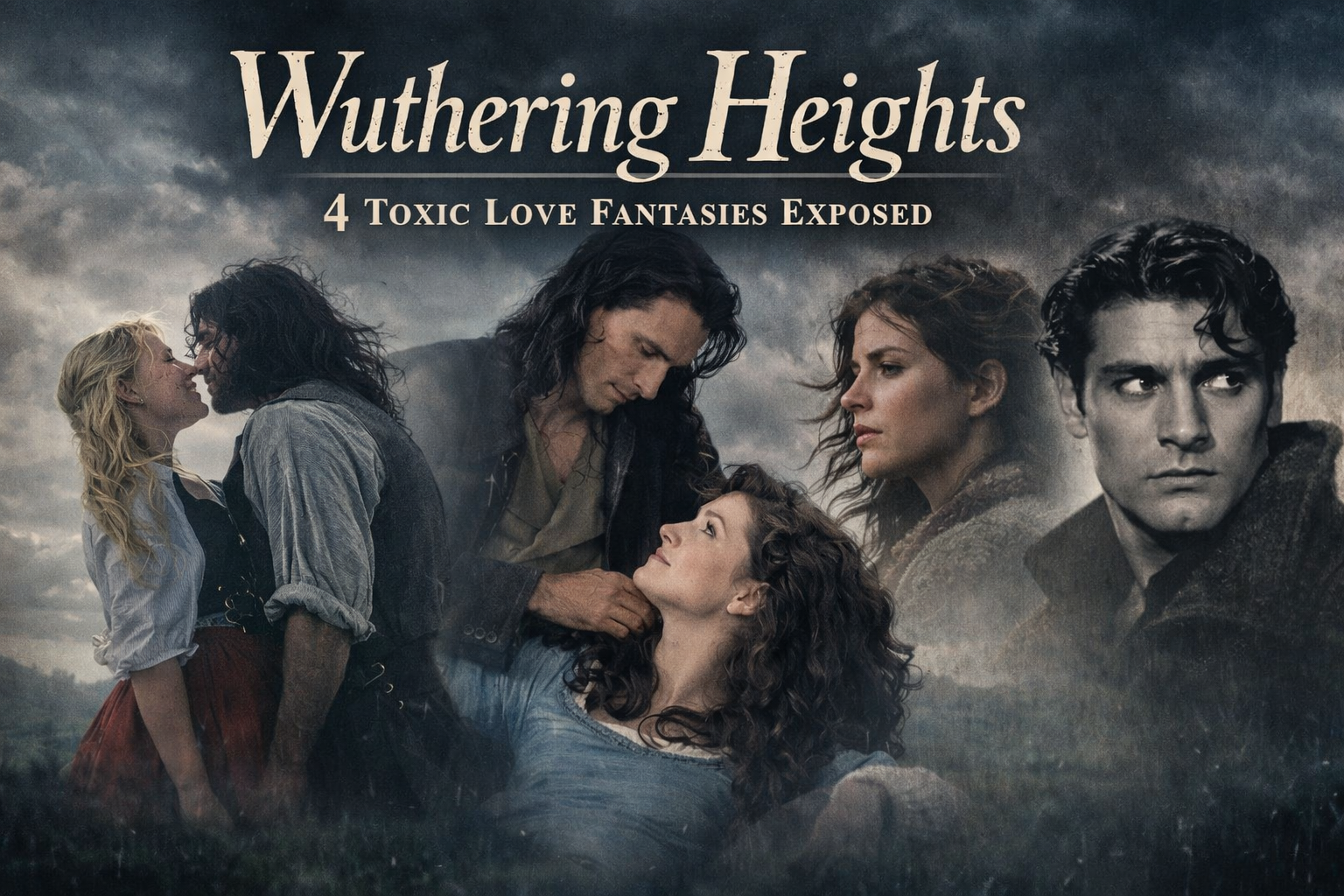
Wuthering Heights is often called an ideal date movie and that label sounds romantic at first glance. The windswept moors, the longing looks, the dramatic passion all feel cinematic. But beneath that aesthetic lies a story far darker than many viewers admit. This article explores why Wuthering Heights keeps being framed as romance and what toxic love fantasies may be hiding inside its emotional storm.
Wuthering Heights sits at the center of a long debate about love and obsession. The novel by Emily Brontë is frequently marketed as epic romance, yet many critics argue it challenges the very idea of romantic idealism. One reviewer described it as “a brutal and disturbing novel” rather than a comforting love story. (Time Out, Fiona Noble, November 7, 2025, Wuthering Heights) (https://www.timeout.com/movies/wuthering-heights)
To understand why this matters, we must define toxic love fantasies. These fantasies elevate emotional intensity over emotional health. They frame suffering as meaningful and obsession as destiny. They blur the line between passion and harm.
Scientific research supports the idea that intense romantic love activates powerful neural reward systems. Scholars describe passionate love as engaging brain pathways similar to addictive processes. (Frontiers in Psychology, Helen E Fisher, Xiaomeng Xu, Arthur Aron, Lucy L Brown, May 10, 2016, Intense, Passionate, Romantic Love: A Natural Addiction? How the Fields That Investigate Romance and Substance Abuse Can Inform Each Other) (https://pmc.ncbi.nlm.nih.gov/articles/PMC4861725/)
When audiences watch Wuthering Heights, they are not simply following a plot. They are experiencing emotional stimulation that feels significant. That stimulation can make unhealthy patterns appear romantic.
Media scholars also argue that traditional storytelling shapes beliefs about relationships. Audiences form parasocial bonds with characters and internalize relationship expectations. (Cambridge University Press, Jesse Fox and Jessica R. Frampton, October 19, 2023, Romantic Relationships and Traditional Media) (https://www.cambridge.org/core/books/sociocultural-context-of-romantic-relationships/romantic-relationships-and-traditional-media/48357654B0D0F39ADC2F89CE03E0DF31)
Wuthering Heights becomes powerful not because it teaches stability, but because it dramatizes emotional extremes.

In Wuthering Heights, obsession is often mistaken for passion. Obsession is an intense fixation on another person that overrides emotional balance, distorts judgment and weakens personal boundaries. Psychologists describe obsessive relational intrusion as persistent pursuit and preoccupation that reflect control rather than secure attachment. (Journal of Interpersonal Violence, Brian H. Spitzberg and William R. Cupach, January 2007, The State of the Art of Stalking: Taking Stock of the Emerging Literature) (https://journals.sagepub.com/doi/10.1177/0886260506294241) Heathcliff’s fixation on Cathy does not soften with time, rejection or consequence. His identity becomes anchored to her presence and her absence. This relentless focus is framed with emotional grandeur, which makes it appear romantic rather than destabilizing.
Passion, in contrast, is intense but not consuming. It energizes connection without erasing autonomy. When obsession is reframed as passion, emotional control begins to look like devotion. The inability to move forward is interpreted as loyalty. Wuthering Heights blurs this boundary by presenting extreme attachment as destiny. The result is a seductive myth that emotional fixation proves depth. In reality, passion strengthens bonds while preserving individuality. Obsession collapses identity into dependence and that collapse is not romance.
In Wuthering Heights, emotional chaos is often portrayed as evidence of true feeling. Cathy and Heathcliff’s interactions do not follow patterns of calm communication or stable connection. Instead they erupt in crisis, fury and dramatic swings between closeness and rejection. This instability gets framed as intensity and depth rather than dysfunction. The louder the emotional fluctuation, the more audiences are led to believe that the love is profound. That assumption echoes common myths in how we interpret strong feelings.
Research on anxiety and emotional dysregulation shows that heightened emotional arousal is not the same as secure attachment or meaningful connection. Some people with anxiety experience rapid mood shifts, fear of abandonment and intense reactions that feel powerful but are rooted in stress responses rather than stability. Kocean24 has explored how anxiety can get misread as passion or depth when what is really present is emotional reactivity and fear driving behavior (Margaret Qualley: 6 Hidden Reasons Early Anxiety Could Shape a Person’s Choices, Kocean24). (https://kocean24.com/margaret-qualley-6-hidden-reasons-early-anxiety/)
Wuthering Heights, intensified by dramatic language and atmosphere, turns chaos into aesthetic. Stormy emotions become poetic instead of problematic. That makes chaos feel like depth to many viewers. In relationships, however, emotional extremes can create confusion, hurt, and instability. Depth in connection comes from understanding and regulation, not from perpetual turbulence. Passion that is constantly destabilizing may feel meaningful on screen, but it often reflects unresolved inner conflict rather than sustainable love.
Wuthering Heights often makes suffering look like proof. The more intense the pain, the more “real” the love seems. Jealousy becomes a signal of emotional investment. Rage becomes a symbol of devotion. This is the fantasy. If a person feels jealous enough, they must care deeply. The story’s gothic mood can make this feel poetic instead of unstable.
Jealousy is not loyalty. Jealousy often grows from insecurity and fear and it can turn into control. Greek myth shows the same pattern in a louder form. Hera is repeatedly portrayed as reacting to Zeus’s affairs with vengeance toward his lovers and their children, including the Semele story where Hera pushes events toward destruction. (TheCollector, Daniel Soulard, February 23, 2025, 9 Myths About the Greek Goddess Hera) (https://www.thecollector.com/hera-greek-goddess-myths/) Her suffering does not protect love. It spreads damage. Wuthering Heights echoes this logic. Jealousy intensifies the drama, but it also signals emotional instability, not romantic depth.
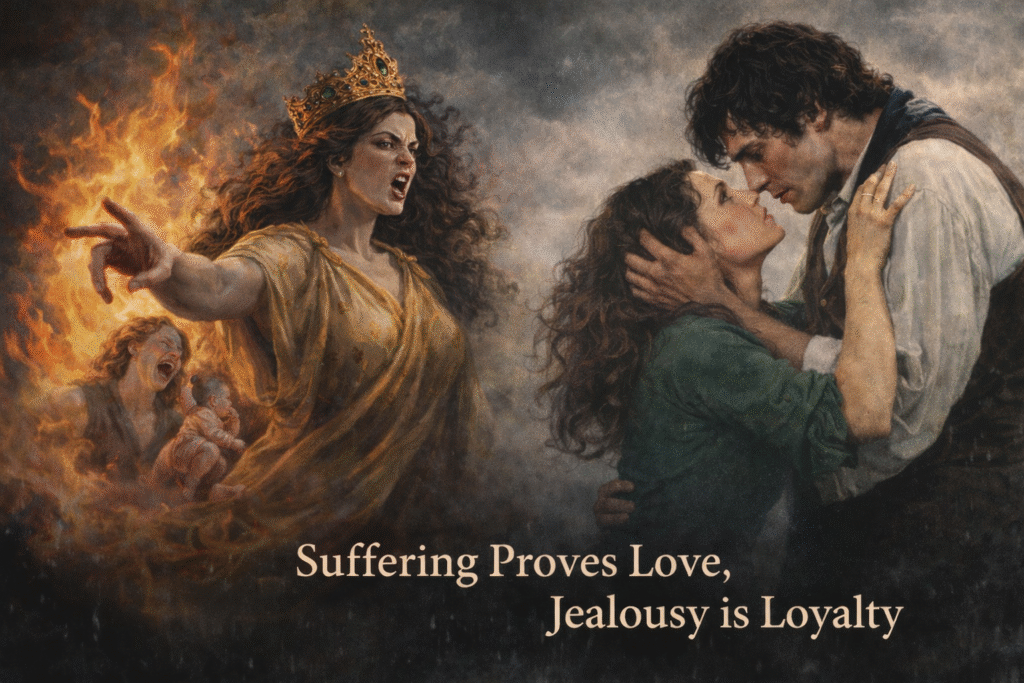
Wuthering Heights does not contain damage within one relationship. Revenge, resentment, and unresolved grief spill across generations. Heathcliff’s fixation reshapes the lives of children who had no part in the original conflict. Emotional harm becomes inheritance. The novel shows how obsession and pride mutate into cruelty. This is not isolated heartbreak. It is systemic destruction.
Yet modern marketing often extracts only the central chemistry and removes the aftermath. The 2026 film adaptation is framed around steamy intensity and dramatic romance during Valentine season release. (People, Emily Blackwood and Nicole Pomarico, January 25, 2026, Wuthering Heights: All About the Upcoming Steamy Film Adaptation Starring Margot Robbie and Jacob Elordi) (https://people.com/all-about-wuthering-heights-movie-11891199) The storm becomes beautiful. The chaos becomes cinematic. When consequences fade from focus, devastation can be misread as passion. Wuthering Heights does not romanticize stability. It reveals what happens when emotional wounds remain unexamined and are allowed to harden into legacy.
Wuthering Heights continues to be called an ideal date movie not because it models healthy love, but because it delivers intensity, atmosphere, and instant emotional engagement. Modern audiences are drawn to stories that feel large and dramatic. The film offers stormy landscapes, charged performances, and morally complex characters. That combination turns a viewing into an event. A date becomes more than passive watching. It becomes shared experience loaded with feeling and meaning.
Here is why it works so well on a date:
a. Emotional Conversation Starter
Wuthering Heights provokes debate. Is the love tragic or toxic. Is Heathcliff romantic or destructive. Couples who watch it together often leave with questions. That exchange can deepen understanding of each other’s values about loyalty, jealousy, and boundaries.
b. Shared Emotional Intensity
Psychological research suggests that shared emotional arousal can increase perceived closeness because heightened feeling becomes associated with the nearby partner. An intense drama can amplify that effect. The emotional charge of the film blends with the memory of the person sitting beside you.
c. Cultural Sophistication Signal
Choosing a literary adaptation for a date can signal depth and intellectual curiosity. Wuthering Heights carries historical and cultural weight. That symbolic value can make the evening feel thoughtful rather than casual.
The label ideal date movie does not mean the relationship on screen is healthy. It means the experience is emotionally stimulating and conversation worthy. When approached critically, Wuthering Heights becomes a reflective mirror. When absorbed uncritically, it risks becoming a romantic blueprint built on instability.

Wuthering Heights has survived generations because it embodies emotional extremity. Its gothic atmosphere and dramatic declarations translate well to modern cinema.
Marketing amplifies this intensity. Valentine season positioning reframes a psychological tragedy as romantic spectacle. (People, Emily Blackwood and Nicole Pomarico, January 25, 2026, Wuthering Heights: All About the Upcoming Steamy Film Adaptation Starring Margot Robbie and Jacob Elordi) (https://people.com/all-about-wuthering-heights-movie-11891199)
Repeated exposure to intense romance narratives shapes belief systems. Media scholars emphasize that traditional storytelling influences expectations about love. (Cambridge University Press, Jesse Fox and Jessica R. Frampton, October 19, 2023, Romantic Relationships and Traditional Media) (https://www.cambridge.org/core/books/sociocultural-context-of-romantic-relationships/romantic-relationships-and-traditional-media/48357654B0D0F39ADC2F89CE03E0DF31)
Wuthering Heights thrives because intensity captures attention. Calm relationships rarely dominate headlines.
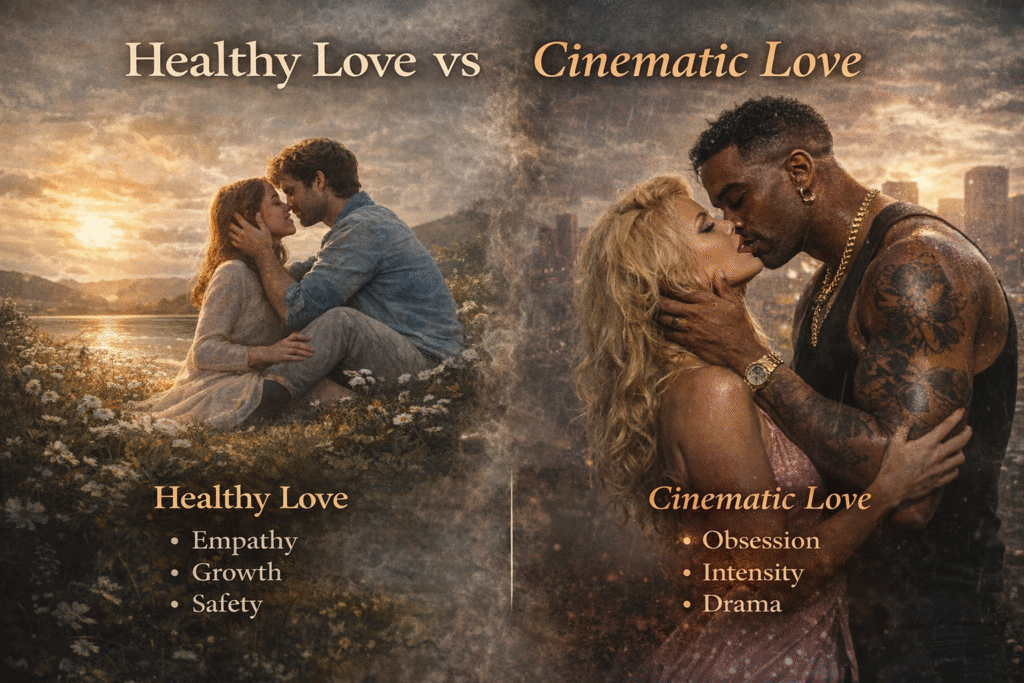
Healthy love is grounded in empathy, accountability, respect and emotional regulation. It values stability over spectacle. It may not appear dramatic, but it creates safety and growth. Conflict is addressed with communication rather than chaos. Passion exists, yet it does not erase individuality or boundaries.
Cinematic love operates differently. It magnifies tension, compresses time, and turns longing into visual intensity. Suffering becomes aesthetic. Conflict becomes narrative fuel. Wuthering Heights belongs to this expressive category. It dramatizes human extremes rather than modeling sustainable partnership. The novel exposes emotional intensity, but it does not prescribe it. Recognizing this difference allows viewers to appreciate the artistry while resisting the temptation to romanticize instability.
Wuthering Heights remains one of literature’s most magnetic stories because it captures emotional intensity at its highest level. It fascinates and unsettles at the same time. Calling Wuthering Heights an ideal date movie reflects modern appetite for dramatic connection rather than a model of healthy love. When viewed with awareness, it becomes a conversation starter. When mistaken for romance guidance, it becomes myth.