Physical Address
304 North Cardinal St.
Dorchester Center, MA 02124
Physical Address
304 North Cardinal St.
Dorchester Center, MA 02124
Mortgage Refinance Rates at 6.62% are not just a housing number. They are a warning about how inflation, bond yields, energy pressure, and household debt are moving together in America. A refinance rate above 6% can change family budgets fast. It can delay savings and stop owners from lowering monthly payments. It can also expose a deeper problem inside the U.S. economy. When borrowing stays expensive for too long, the pressure moves from home loans into spending, confidence, and growth.
Mortgage Refinance Rates moved back into national focus after the average 30 year fixed refinance rate reached 6.62% in America. (Yahoo Finance, May 14, 2026, Mortgage and refinance interest rates today, May 14, 2026) (https://finance.yahoo.com/personal-finance/mortgages/article/mortgage-refinance-interest-rates-today-thursday-may-14-2026-100000554.html)
The importance of that figure becomes clearer when compared with broader market data. Freddie Mac said the average 30 year fixed mortgage rate stood at 6.37% during the first week of May, showing that refinancing remains more expensive than many existing home loans created during the low rate era of 2020 and 2021. (Freddie Mac, May 7, 2026, Mortgage Rates Average 6.37%) (https://freddiemac.gcs-web.com/news-releases/news-release-details/mortgage-rates-average-637)
That difference matters because refinancing only creates value when borrowers secure meaningful savings after lender fees, closing costs, and long term interest exposure. Millions of Americans still hold mortgages below 4%. For those households, refinancing into a loan above 6% can increase total borrowing costs instead of reducing financial pressure.
The market is also reacting to uncertainty surrounding inflation and Federal Reserve policy. Reuters reported that major financial institutions including Goldman Sachs and BofA delayed expectations for U.S. rate cuts because inflation risks remain elevated. (Reuters, Kanishka Singh, May 11, 2026, BofA and Goldman push back Fed rate cut expectations on inflation risks, jobs data) (https://www.reuters.com/business/goldman-sachs-delays-fed-cut-outlook-december-2026-iran-war-drives-us-inflation-2026-05-11/)
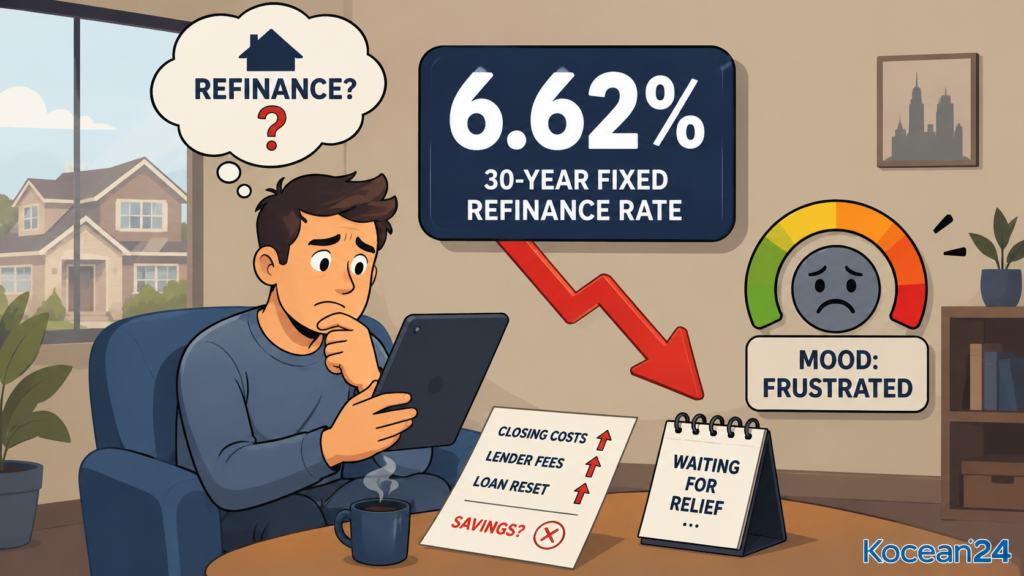
This creates a difficult economic zone. Mortgage Refinance Rates are no longer exploding upward like a crisis shock, but they are still high enough to block broad refinancing relief. That middle pressure zone weakens household flexibility, limits debt restructuring, and keeps many homeowners trapped between older low rate loans and a more expensive borrowing environment.
Mortgage Refinance Rates usually follow the direction of U.S. Treasury yields because lenders price long term mortgage risk against broader bond market conditions. Forbes Advisor noted that mortgage rates follow U.S. Treasury bond yields, and when yields fall, mortgage rates generally follow. (Forbes Advisor, May 14, 2026, Mortgage Rates Today: May 14, 2026 – Rates Climb For 4th Straight Day) (https://www.forbes.com/advisor/mortgages/mortgage-rates-05-14-26/)
Mortgage Refinance Rates therefore reflect much more than housing demand. They also reveal how investors view inflation risk, Federal Reserve policy, government debt pressure, and long term economic stability in America.
This connection creates a deeper financial chain reaction:
a. Higher Treasury Yields
When Treasury yields remain elevated, lenders demand stronger returns before approving mortgage loans. That added protection appears through higher refinance pricing, stricter lending standards, and weaker affordability for borrowers.
b. Inflation Expectations
Bond investors closely monitor inflation because persistent price growth reduces the future value of fixed income returns. If markets believe inflation will stay elevated, Treasury yields often rise further, pushing Mortgage Refinance Rates higher across the economy.
c. Federal Reserve Uncertainty
Mortgage markets also react to expectations surrounding future Federal Reserve decisions. If investors expect delayed rate cuts or tighter monetary policy, long term yields can remain high even without immediate Fed action.
d. Pressure on Households
For ordinary homeowners, this means refinancing becomes harder even when property values remain strong. Families seeking payment relief face a market where borrowing costs are shaped not only by banks, but by inflation fears, federal debt costs, and investor confidence across Wall Street.
Mortgage Refinance Rates become harder to reduce when inflation refuses to cool. Reuters reported that BofA Global Research and Goldman Sachs delayed their U.S. Federal Reserve rate cut expectations because of elevated inflation linked to high energy prices and labor market strength. (Reuters, Kanishka Ajmera, May 11, 2026, BofA and Goldman push back Fed rate-cut expectations on inflation risks, jobs data) (https://www.reuters.com/business/goldman-sachs-delays-fed-cut-outlook-december-2026-iran-war-drives-us-inflation-2026-05-11/)
This is where the refinance market turns into a wider economic stress signal. Homeowners are searching for cheaper borrowing costs, but financial markets are demanding stronger proof that inflation is finally weakening. At the same time, the Federal Reserve remains cautious because cutting rates too early could restart price pressure across the economy. That tension keeps Mortgage Refinance Rates trapped in an uncomfortable middle zone where relief remains visible, but unreachable for many families.
The consequences move far beyond housing loans. Persistent inflation keeps Treasury yields elevated. Elevated yields push refinancing costs higher. Expensive refinancing limits household flexibility because families lose opportunities to reduce monthly obligations, restructure debt, or recover spending power after years of rising living costs.
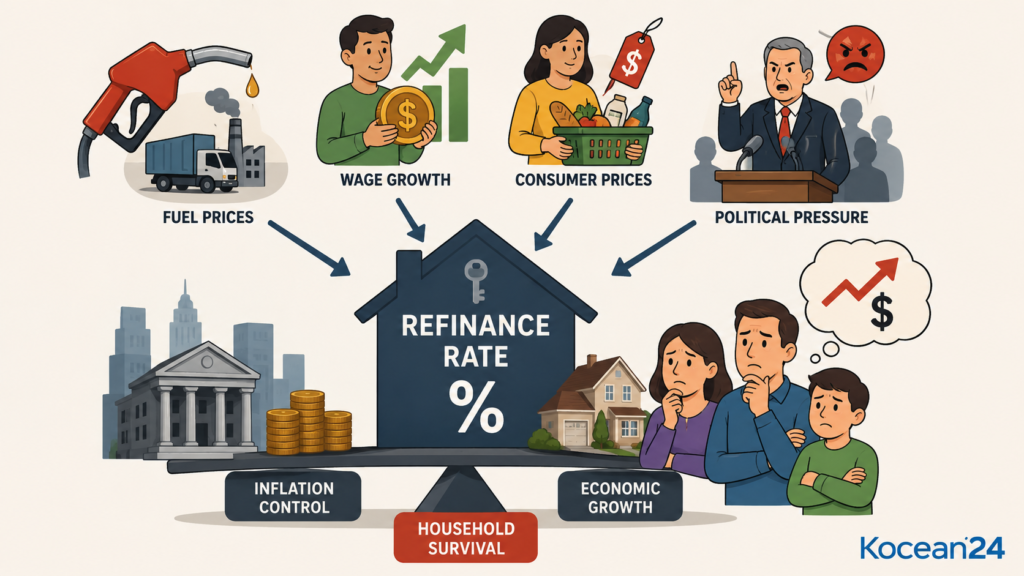
Mortgage Refinance Rates are therefore reacting to several economic forces at once. Fuel prices influence transportation and production expenses. Wage growth shapes inflation expectations. Consumer demand affects pricing pressure across industries. Political leaders also face growing public frustration when borrowing costs remain elevated for too long. A single refinance rate now reflects a much larger struggle between inflation control, economic growth, and household survival in America.
Mortgage Refinance Rates cannot be understood in isolation because the broader housing market remains under heavy affordability pressure. Freddie Mac reported that the average 30 year fixed mortgage rate stayed above 6% during early May 2026, showing that both home purchasing and refinancing continue to operate inside an expensive borrowing environment. High property prices, elevated insurance costs, rising taxes, and stricter lending standards are combining to reduce financial flexibility for millions of households.
The pressure becomes clearer when monthly payment structures are compared. A 15 year fixed mortgage averaged around 5.72% during the same period, offering lower long term interest exposure than a typical 30 year refinance. Yet the shorter repayment window sharply increases monthly obligations. For many middle income families, lower interest rates alone are not enough to offset the larger payment burden created by compressed loan terms.
This creates a divided housing reality across America:
Higher Income Borrowers
Wealthier households still retain mobility inside the market. Stronger credit profiles, larger cash reserves, and higher home equity allow them to refinance selectively, negotiate better lender terms, or shift into shorter duration loans more comfortably.
Middle Income Families
Middle class borrowers face the most difficult balancing act. Many already hold older low rate mortgages but struggle with rising living costs, insurance bills, childcare expenses, and credit obligations. Refinancing at current rates often fails to produce meaningful payment relief after fees and closing costs are included.
Lower Income Households
Lower income borrowers face even tighter limits. Higher rates reduce approval chances, increase debt to income pressure, and restrict refinancing access almost entirely. Many families in this category are forced to absorb inflation without the financial tools that wealthier households still possess.
Mortgage Refinance Rates therefore expose more than housing costs. They reveal how unevenly financial pressure is spreading across American society. The market still functions, but relief is no longer reaching every income group equally.
Mortgage Refinance Rates are now being shaped by forces far beyond housing. Kocean24 recently reported that U.S. inflation reached 3.8% over the 12 months ending April as war related energy pressure raised public frustration. (Kocean24, Alex Hamilton, May 12, 2026, 3.8% Inflation in US Sparks Shocking Civil Anger against Trump) (https://kocean24.com/inflation-in-us-iran-war-trump-civil-society/)
This economic chain carries direct consequences for ordinary borrowers. Rising energy costs increase shipping, manufacturing, and transportation expenses across the economy. Those higher operating costs often push consumer prices upward, making inflation harder to control. As inflation remains stubborn, the Federal Reserve becomes less willing to cut interest rates aggressively. That caution keeps borrowing costs elevated across financial markets, including refinancing. In the end, global energy pressure and inflation policy decisions can directly affect the monthly payment calculations facing an American homeowner.
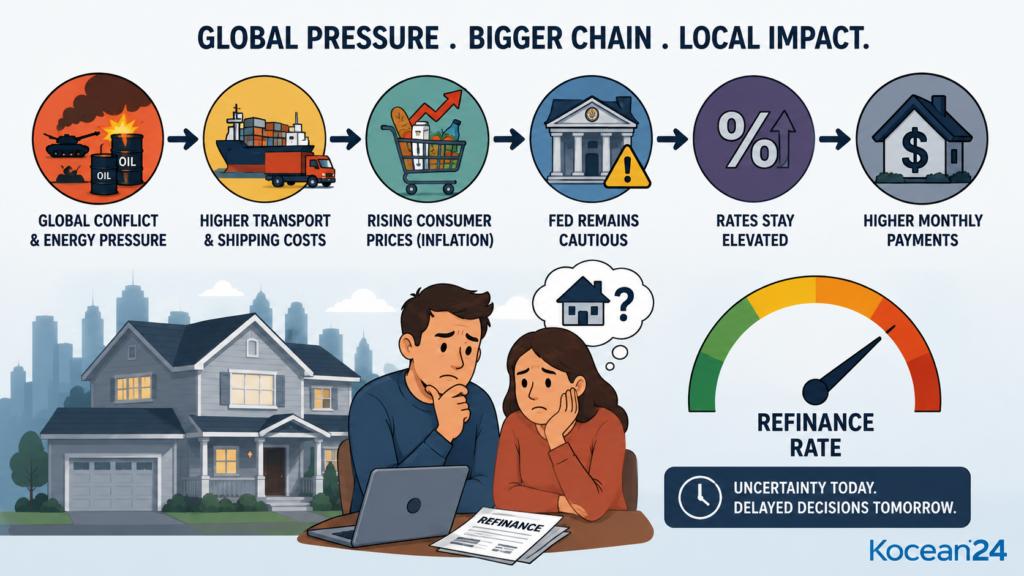
Mortgage pressure is therefore expanding beyond the housing sector. It now reflects broader economic anxiety and weakening public confidence. Families do not make long term financial commitments based only on current income. They also react to expectations about inflation, job security, fuel costs, and future borrowing conditions. When economic signals remain unstable, households become more defensive, home purchases slow and refinancing decisions get delayed. Large financial commitments start feeling riskier even for middle income earners.
Mortgage Refinance Rates become a signal of public hesitation. Homeowners may want to reduce payments, but they also fear locking into the wrong moment. That fear slows action.
Mortgage Refinance Rates can become a wider economic threat when they reduce household financial flexibility across millions of families at the same time. Refinancing normally helps homeowners lower monthly obligations, restructure debt, free cash for emergencies, support education costs, or manage inflation pressure more effectively. When refinance rates remain elevated, that financial breathing space disappears.
More income stays locked inside housing payments instead of circulating through consumer spending, local businesses, savings, or long term investment activity. Over time, this weakens confidence, slows household mobility, and increases financial caution across the broader economy.
The economic pressure spreads through several connected areas:
• Consumer Spending Weakens
Families facing higher mortgage costs often reduce discretionary spending on travel, retail purchases, dining, and entertainment. That slowdown eventually affects business revenue and hiring activity.
• Housing Supply Tightens
Homeowners holding older low rate mortgages become less willing to sell because moving into a new loan environment creates higher monthly costs. This reduces available housing inventory and keeps affordability pressure elevated for younger buyers.
• Home Improvement Activity Slows
Expensive refinancing limits access to cheaper borrowing for renovations, repairs, and property upgrades. Contractors, suppliers, and local construction sectors can feel the impact.
• Financial Anxiety Increases
Mortgage stress also affects public psychology. Families uncertain about future borrowing conditions often delay large financial decisions, postpone investments, and build defensive savings habits even before income declines appear.
• Economic Growth Faces Pressure
When refinancing activity slows nationally, less money flows back into the economy through consumer circulation. That weakens one of the important financial adjustment tools American households historically used during periods of inflation pressure.
Mortgage Refinance Rates therefore represent more than housing finance. They have become an indicator of consumer confidence, economic flexibility, and the financial resilience of middle class America.
Mortgage Refinance Rates are entering a highly sensitive period where inflation data, Treasury yields, energy prices, and Federal Reserve decisions may shape the next direction of the market more strongly than housing demand itself.
• Softer inflation could slowly reduce refinance pressure
• Higher Treasury yields could keep borrowing costs elevated
• Rising energy prices could trigger fresh inflation fears
• Delayed Federal Reserve cuts could extend mortgage stress
• Stronger market confidence could revive refinancing activity
• Economic uncertainty could delay homeowner decisions
• Household debt pressure could push emergency refinancing
Mortgage Refinance Rates are therefore approaching a decisive economic turning point for American households.
Mortgage Refinance Rates at 6.62% show how deeply America’s housing market is tied to wider economic stress. This is not only about refinancing a home loan. The question is whether households can regain breathing room while inflation, energy costs, and bond yields keep pressure alive. If rates fall, relief can return slowly. If they stay elevated, America may face a longer cycle of housing stress and weaker consumer confidence.









[…] Kocean24 recently explained that mortgage refinance rates above 6% are not just housing numbers. They can affect family budgets, savings plans and the wider economy. (Kocean24, Alex Hamilton, May 15, 2026, 6.62% Mortgage Refinance Rates and America’s Economic Threats) (https://kocean24.com/mortgage-refinance-rates-americas-economic-threats/) […]