

JetBlue enters the second half of 2026 with a rare combination of opportunity and pressure. Spirit Airlines has left valuable space in the South Florida market, giving JetBlue room to add routes, attract passengers and recruit experienced aviation workers. Yet growth alone cannot solve the airline’s deeper financial problems. Higher operating expenses, volatile fuel prices, heavy debt and the difficult task of turning expansion into sustainable profit have placed the company under intense scrutiny.
The situation is not a simple story of collapse. JetBlue still has meaningful liquidity, valuable assets, strong customer recognition and improving revenue performance. However, the airline must now execute several difficult moves at once. It needs to control costs, protect cash, improve reliability and make its expanding Fort Lauderdale network profitable. Any major mistake could weaken investor confidence at a critical moment.
Table of Contents
JetBlue is Growing While Costs Rise Faster
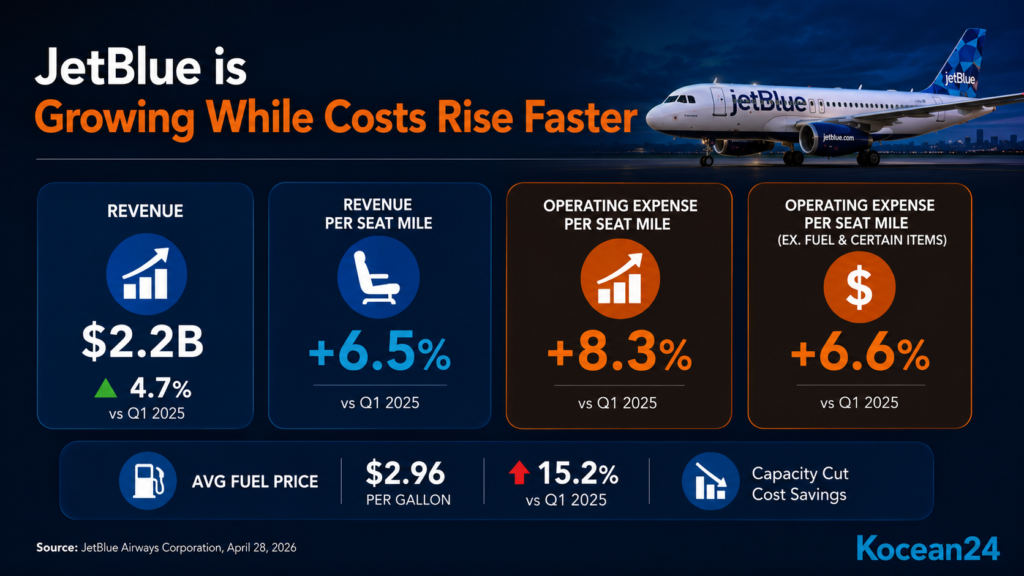
JetBlue reported first quarter operating revenue of $2.2 billion, representing growth of 4.7% from the same period in 2025. Revenue per available seat mile increased by 6.5 percent, showing that demand and pricing improved. However, operating expense per available seat mile rose by 8.3%, while the measure excluding fuel and certain other items increased by 6.6%.
That gap matters. An airline can sell more tickets and generate stronger revenue, but it still struggles when costs rise faster than income. JetBlue must therefore improve both revenue and efficiency. More passengers do not automatically produce stronger profit when fuel, maintenance, staffing and operational disruption continue to consume cash.
The airline also said its average fuel price reached $2.96 per gallon during the first quarter, which was 15.2% higher than one year earlier. Management responded by reducing planned capacity during weaker travel periods and introducing additional savings. (JetBlue Airways Corporation, April 28, 2026, JetBlue Announces First Quarter 2026 Results) (https://ir.jetblue.com/news/news-details/2026/JetBlue-Announces-First-Quarter-2026-Results/default.aspx)
Fuel Pressure Can Quickly Change the Outlook
Fuel remains one of the largest and least controllable airline expenses. Carriers can adjust schedules, reduce weaker flights and raise some fares, but they cannot fully control global energy markets.
JetBlue expected only 30% to 40% of higher fuel costs to be recovered during the second quarter. Full recovery was not expected until early 2027. That leaves the company exposed if fuel prices remain elevated or increase again.
Higher fares may help, but passengers are price sensitive. Raising ticket prices too aggressively could push travelers toward larger competitors with broader route networks and more frequent schedules. JetBlue must find a balance between protecting revenue and keeping its fares attractive.
Heavy Debt Limits Financial Flexibility
The largest financial concern is the company’s debt burden. At March 31, 2026, JetBlue reported $8.494 billion in total debt and finance lease obligations. Current maturities stood at $734 million, while long term debt and finance lease obligations reached $7.701 billion.
The company later repaid $325 million in convertible senior notes due in 2026. It also arranged up to $500 million in financing secured by aircraft, with the possibility of increasing that amount by another $250 million.
These actions provide breathing room, but they do not remove the broader pressure. Debt requires interest and principal payments regardless of whether travel demand strengthens or weakens. It can also restrict how freely management invests in aircraft, technology, airport operations and customer service.
The company’s official quarterly filing recorded total debt with a carrying value of $8.435 billion at the end of March. (U.S. Securities and Exchange Commission, April 28, 2026, JetBlue Airways Corporation Form 10-Q for the Quarterly Period Ended March 31, 2026) (https://www.sec.gov/Archives/edgar/data/1158463/000115846326000061/jblu-20260331.htm)
Liquidity Provides Time, Not a Turnaround
JetBlue’s liquidity reduces the risk of an immediate cash crisis, but it does not fix the company’s underlying earnings problem. The airline entered 2026 with substantial cash, borrowing capacity and aircraft that could support additional financing. However, its weak credit profile means new debt may come with higher interest costs and tighter terms.
The pressure becomes serious if fuel remains expensive or passenger demand weakens. Fitch analyst Joseph Rohlena said liquidity was not an immediate concern, but warned that continued cash burn could force JetBlue to raise more capital. Fitch also cut the airline’s credit rating to CCC plus because its earnings may not adequately cover fixed expenses. (Reuters, Doyinsola Oladipo, April 27, 2026, Big fuel bill, Spirit bailout may upend JetBlue Airways return to profitability) (https://www.reuters.com/business/big-fuel-bill-spirit-bailout-may-upend-jetblue-airways-return-profitability-2026-04-27/)
The key issue is cash generation. JetBlue must produce enough operating cash to fund flights, service debt and invest in its network without repeatedly using aircraft as collateral or returning to lenders. Liquidity gives management time to execute the turnaround. Only sustained profitability can make that protection permanent.
Fort Lauderdale Expansion Creates a Major Test
Fort Lauderdale is becoming the center of the airline’s growth strategy. JetBlue launched 8 nonstop destinations from the airport on July 9 and announced another 6 routes for later in the year.
The airline said it would operate more than 125 daily departures to over 55 nonstop destinations from Fort Lauderdale. It expects to reach approximately 150 daily flights during the winter. Daily departures have increased by more than 75% compared with the same period one year earlier.
This expansion gives JetBlue access to travelers across Florida, the Caribbean, Latin America and major United States cities. It also creates more connecting opportunities, which can improve aircraft use and attract customers who need more than a simple direct flight.
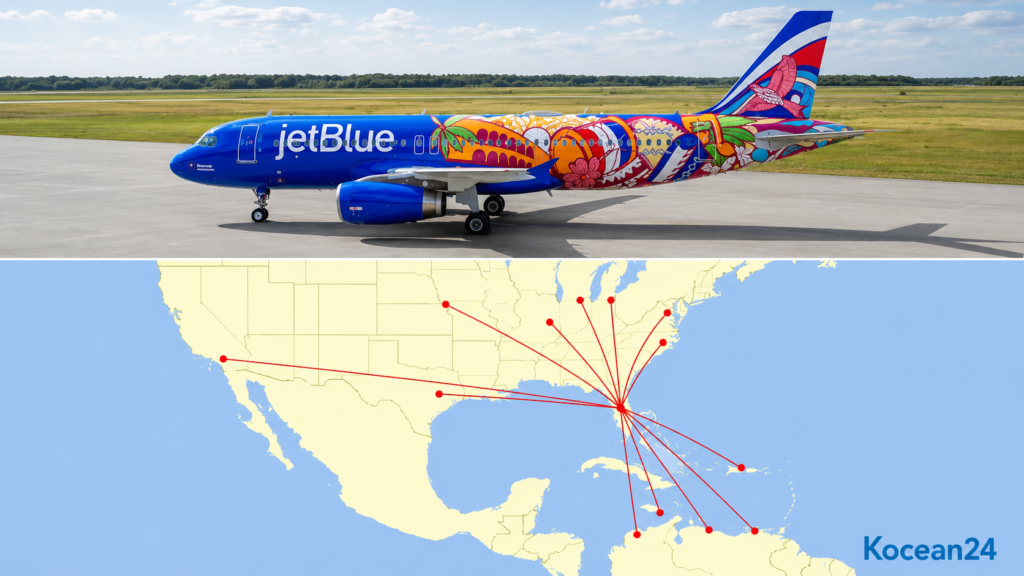
JetBlue described the schedule as the largest it has ever operated at Fort Lauderdale. (JetBlue, July 9, 2026, JetBlue Launches Largest-Ever Fort Lauderdale Schedule, Reinforcing Long-Term Commitment to South Florida) (https://news.jetblue.com/latest-news/press-release-details/2026/JetBlue-Launches-Largest-Ever-Fort-Lauderdale-Schedule-Reinforcing-Long-Term-Commitment-to-South-Florida/default.aspx)
Rapid Growth Can Create Operational Strain
Adding flights is easier than operating them consistently. A larger schedule requires enough pilots, cabin crew, maintenance teams, gates, aircraft and customer support workers.
Even a small disruption can spread through a tightly connected network. Bad weather, aircraft maintenance or crew shortages can delay one flight and affect several later departures. The risk becomes greater when an airline expands quickly from one major airport.
Kocean24 previously examined how weather, software failures, weak planning and operational pressure can turn limited problems into widespread disruption. (Kocean24, Alex Hamilton, May 5, 2026, Flight Delays: 7 Most Shocking Cases in History and Their Real Impact) (https://kocean24.com/flight-delays-7-most-shocking-cases-history-impact/)
JetBlue must therefore prove that Fort Lauderdale can become a dependable hub rather than an expensive collection of new routes. Customer experience will matter as much as passenger numbers.
Investor Concerns are Becoming More Serious
The strongest warning has come from analysts examining the company’s capital structure. Raymond James analysts Savanthi Syth and Carter Eades downgraded JetBlue shares from market perform to underperform.
The analysts said they did not expect a liquidity crisis during 2026 without another major economic shock. However, they argued that addressing the capital structure through Chapter 11 could be a prudent course.
The distinction is important. JetBlue continues to operate, expand and finance its business. Still, the fact that a major analyst raised restructuring as an option shows how seriously investors are viewing the debt burden and limited upside for shareholders. (The Wall Street Journal, Dean Seal, July 6, 2026, Auto & Transport Roundup: Market Talk) (https://www.wsj.com/business/auto-transport-roundup-market-talk-7e199517)
Bankruptcy Rumors Must Be Treated Carefully
Online speculation has blurred the difference between financial pressure and an actual bankruptcy filing. JetBlue carries substantial debt, faces rising costs and has received a negative analyst assessment, but the airline continues operating, expanding its Fort Lauderdale network and maintaining access to liquidity. No verified company announcement or court filing has confirmed that JetBlue has entered Chapter 11.
The distinction is clear:
• Financial risk does not mean immediate insolvency.
• An analyst recommendation does not represent a company decision.
• A possible future restructuring is not a confirmed bankruptcy filing.
JetBlue’s position remains serious, but the facts support caution rather than panic. The company is under pressure to improve profitability and cash generation, yet bankruptcy claims should not be presented as fact without an official filing.
The Turnaround Must Deliver Real Profit
The company’s JetForward strategy aims to improve earnings through network changes, premium products, loyalty revenue and cost control. Management said the plan remained on track to produce $310 million in incremental earnings before interest and taxes during 2026.
That target matters because JetBlue cannot depend only on borrowing, asset financing or temporary market openings. The business must produce stronger returns from regular operations.
Premium cabins and loyalty partnerships may support that effort. First quarter premium cabin revenue performance grew faster than the airline’s core product, while loyalty cash remuneration increased by 19 percent. These areas can provide higher margin revenue than basic ticket sales.
However, execution will decide the outcome. A promising route network, popular customer product and growing loyalty program will have limited value if high costs continue absorbing the gains.
What JetBlue Must Do Next
JetBlue has an opportunity to strengthen its position, but long term success now depends on disciplined execution, sustainable profitability and consistent operational performance.
Key priorities include:
a. Focus on Profitable Routes
Fort Lauderdale expansion should be guided by route profitability, not network size. High performing routes deserve additional capacity, while consistently weak services should be reviewed and adjusted quickly.
b. Strengthen Cost Discipline
Management must reduce operating costs without compromising reliability or customer experience. Efficient scheduling, fuel management and productivity improvements can support better margins.
c. Improve Financial Confidence
Clear communication on debt reduction, liquidity, cost savings and earnings progress will help rebuild investor confidence and demonstrate that the turnaround strategy is delivering measurable results.
d. Protect the JetBlue Brand
JetBlue’s competitive advantage lies in its customer experience, premium economy offering and value driven service. Preserving those strengths while expanding will be essential to maintaining passenger loyalty and long term growth.
Conclusion
JetBlue is facing serious risks in 2026, but its future has not been decided. The airline has a valuable opening in Fort Lauderdale, improving revenue trends and enough liquidity to continue its strategy. It also carries heavy debt, rising expenses and growing pressure to prove that expansion can produce sustainable profit.
The next several quarters will reveal whether management can turn a market opportunity into a lasting recovery. JetBlue does not need more attention or louder promises. It needs disciplined execution, reliable operations and stronger cash generation. That is how the airline can move beyond restructuring speculation and rebuild confidence among passengers, employees and investors.